Independent Media & Commentary from the Cursed Prophetess of Troy
Primary Menu
Author: cassandrasboxmedia
Independent Writer from the UK, blending alternative media perspectives, gender critical views, conspiracy, left wing politics and economics, support for Julian Assange and alternative spirituality.
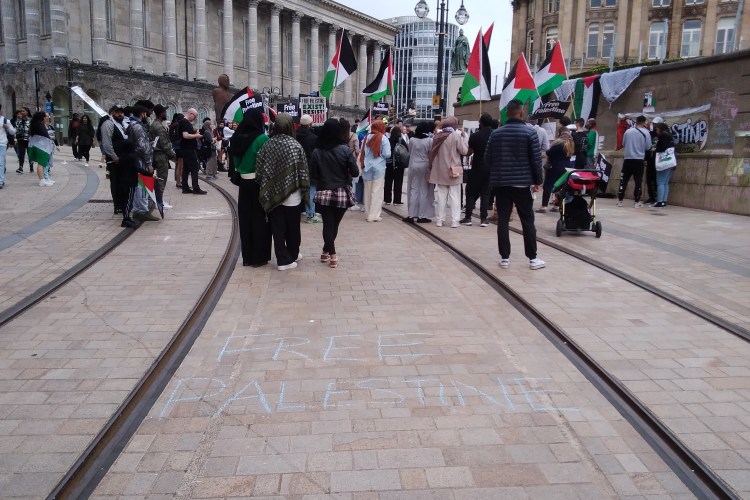
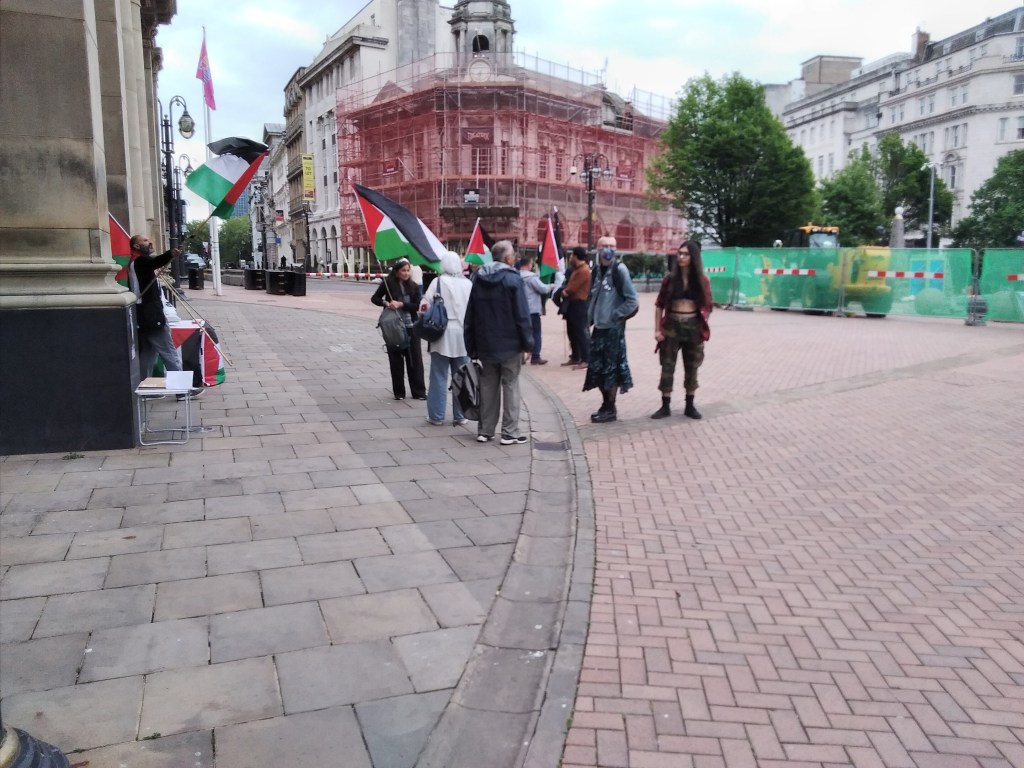
I attended a protest for Palestine on the 15th May. The day before, there was a protest in London that had been planned on the anniversary of the Nakba of 1948. I didn’t go to London but some footage can be seen here.
It was a pretty small protest. It was due to start at 2pm, but at this time there was hardly anyone there.
More people began to trickle in after 2pm, so the crowd became closer to 150 people.
Initially the protest was in the square proper, but it was moved to make it more visible to passers by.
There was both chants being led and some speeches. Some children (I’m guessing under the age of 10) also led chants, which I didn’t film as I don’t want to put that online (I try to avoid filming children if possible).
The Official Covid Narrative, the idea that Covid-19 is an extremely dangerous disease that requires severe mitigation strategies such as lockdown, views human beings as simply disease carriers. However, some categories of people are viewed more as disease carriers than others by the official narrative, and specifically by the believers in that narrative. The narrative itself is inherently linked to certain middle and upper class attitudes about the working classes and their beliefs and pursuits. This is seen through the demonisation of working class people for carrying out ordinary everyday activities and for being sceptical of big pharma.
The Great Unwashed
From 23 March 2020, near the entirety of the country was compliant with Boris Johnson’s draconian lockdowns. As someone who was a sceptic of the narrative from the beginning, it was depressing and almost hopeless to see the state of the country at that time.
The first possible signs of actual social life came about through the suggestion of V.E. Day anniversary celebrations. 8th May 2020 marked the 75th anniversary of the defeat of Nazi Germany, so at that point the British people had endured about 6 weeks of lockdown. This was the first sign of life in the country since the beginning of the tyranny.
This is when the middle class handwringing started. The idea of celebrating V.E. Day does not suit middle class Remainer sensibilities, as they consider it to be too nationalistic. They already had a negative conception of the ‘insular’ working class who largely voted for Brexit, so they were already psychologically primed for mass demonisation. And now the working class were to commit the mortal sin in the minds of middle class hypochondriacs: going outside to celebrate a holiday.
Furthermore, there were images of packed beaches from the late spring and summer of 2020. The media salivated over these images, mocking and cursing those who went to the beach. This article provides an example of such strategies, entitled ‘Bournemouth raises alarm as huge crowds ignore COVID advice and flock to the coast’. People having a good time in good weather is now considered to be a ‘major incident’.
The Great Unjabbed
Since the rollout of the Covid 19 injections to the population at large, the demonisation has been squarely aimed at the unjabbed. The official narrative had divided the population into two halves: the virtuous ‘fully vaccinated’ (and now ‘boosted’) populations, and the selfish, evil ‘unvaccinated’ who are subhuman vectors of disease.
Leaving the irrationality of this narrative aside for a moment, here is a large dose of snobbery behind the demonisation of the ‘unvaccinated’. The reality is, people from poorer communities and racial minorities are much less likely to have taken the jabs than middle class white people.
Official government data is contested when it comes to how many people have actually taken the jabs. The government likes to cite a figure of 5m ‘unvaccinated’, making the uninjected quite a small minority. The Expose has used another government document to contest this, claiming this document shows that in fact 15.3m eligible people have not taken a single dose.
Even according to the more official data, however, take up is lower in poorer and ethnic minority communities. The website OpenSafely.org gives data on vaccine coverage in the UK (and is linked and used as a source by the BBC, so it’s establishment approved). Their charts clearly show that ethnic minorities and more deprived areas have a lower vaccination take up. Even if the numbers themselves are overshot per The Expose above, I doubt that the trends themselves are inaccurate.
The demonisation of the ‘unvaccinated’ thus has a clear class element.
There is also another aspect to this which we saw strongly during the Brexit argument and that is the ‘working class are stupid’ aspect. The Guardian published an article called ‘Understanding, not judgment, should shape our response to those who remain unjabbed’ which is full of the kind of talking down beloved of middle class British liberals.
By way of getting to the heart of it all, a PowerPoint presentation she sent me made mention of “historic lack of trust in public institutions including health services within some groups and communities”. In some black communities, she said, people’s relationships with authority are so poor that that some have chosen to be vaccinated well away from where they live and work, “because they’re almost embarrassed to be vaccinated, thinking their community isn’t behind them.” She paused. “There’s no easy fix. We just keep on talking.”
The implication of this article is that we need some nice middle class liberals to go and talk to these ‘stupid’ black people who don’t trust authority. There’s no consideration here that people may have actually said no and mean no and have the agency to do so.
This is the flipside to the demonisation of the ‘unvaccinated’ as subhuman – they can either be maliciously subhuman, in that they are purposeful granny killers, or they can be stupidly subhuman, in that they require enlightenment by the evangelists of the Covid Cult.
There is a more serious point to all of this snobbery, which is that the Covid narrative is an attack on ordinary working people in a multitude of ways. This attack is justified through this snobbery in the minds of the petty middle class, who are already inclined to view the working class as ignorant Brexit voters who ruined their nice holidays in Marbella.
Lockdown is a war on the working class. Firstly, it is an attack on the rights of the working class to congregate and organise politically in order to represent their interests, as well as to protest against the governments and corporations imposing poor working conditions and wages on them.
Lockdown is also an economic war against the working class and a massive transfer of wealth upwards from ordinary people. Multiple sources have highlighted this massive growth in wealth, including many that are supporters of the Official Covid Narrative. According to inequality.org:
The world’s billionaires have seen their wealth surge by over $5.5 trillion since the beginning of the pandemic in March 2020, a gain of over 68 percent. The world’s 2,690 global billionaires saw their combined wealth rise from $8 trillion on March 20, 2020 to $13.5 trillion as of July 31, 2021, drawing on data from Forbes.
Global billionaire total wealth has increased more over the past 17 months of the pandemic than it did in the 15 years prior to the pandemic. Between 2006 and 2020, global billionaire wealth increased from $2.65 trillion to $8 trillion, a gain of $5.35 trillion.
With unprecedented support from governments for their economies, the stock market has been booming, driving up billionaire wealth, even while the real economy faces the deepest recession in a century. In contrast, after the financial crisis in 2008, it took five years for billionaire wealth to return to its pre-crisis highs.
Worldwide, billionaires’ wealth increased by a staggering $3.9tn (trillion) between 18 March and 31 December 2020.28 Their total wealth now stands at $11.95tn, which is equivalent to what G20 governments have spent in response to the pandemic. The world’s 10 richest billionaires have collectively seen their wealth increase by $540bn over this period.
Working class wealth has nosedived due to the lockdowns. Workers have been forced to work from home and this has increased their exploitation according to Ted Reese:
Much of the workplace has been moved to the home, saving capital costs on office space; pushing running costs such as electricity and water bills onto workers; and making them work longer hours, all combining to deepen the rate of their exploitation. About 30% of remote workers in a UK survey said they were working more unpaid hours than before lockdown, with 18% reporting at least four additional unpaid hours a week. According to an ADP Research Institute study, employees globally are now working 9.2 hours per week of unpaid overtime on average, up from 7.3 hours in a year.
The terrible inflation we are currently observing – at least partially caused by the lockdowns – is another aspect of war on the working class. The middle classes can weather this inflation through higher wages and the money they accrued while getting paid free cash on furlough. This isn’t an option for the working class.
The mandatory Covid injections implemented by the establishment are also an attack on the bodily integrity of the working class. The government forced care home workers to take these injections or they would be fired. Care home workers are poorly paid members of the working class, with an average wage of £8.50 an hour. They are also primarily women. Care home workers were fired from their jobs for not taking these injections in December 2021, or were forced to leave and find other work. Although the mandate was later repealed the damage was done in terms of lost wages and jobs. Other countries are still implementing such policies.
Snobbery also allows for the demonisation of resistance to the authoritarian project launched in the name of ‘fighting Covid’. This has been seen most notably in the case of the ‘Freedom Convoy’. The Convoy emerged in Canada in response to Justin Trudeau’s particularly authoritarian Covid measures. In response other convoys have taken inspiration for their own movements including in the UK. Due to the fact that this movement is founded by working class people, it has been demonised by people in the media and their woke left allies. The movement has been smeared as ‘white supremacist’ (despite the clear participation of people of all races).
The portion of the left that hates the working classes has also been brought in to smear the convoys as ‘right wing’. One example is previously respected anti-imperialist commentator Ben Norton, who has been demonising people opposed to the injection mandates:
The same line is being parroted by the liberal media that the likes of Norton claim to oppose. The Conversation ran a hit piece on the truckers, claiming that because they aren’t virtue signalling about ‘transphobia’ they don’t care about freedom and that they want the freedom to kill people because they reject mandating an experimental injection. This demonisation helps to keep the middle classes in the Covid propaganda bubble.
Conclusion
One function of lockdowns was a massive transfer of wealth to the rich from the poor and working class. The political acceptability of such a project – in the UK in particular – was maintained through the demonisation of the working classes.
The first two posts in these series discussed the current situation in Ukraine from the point of view of geopolitics and an anti-imperialist critique of Western actions. However, while the points made in those posts were based on factual evidence, there is one point that hasn’t been discussed so far. That is the fact that this Ukraine narrative swooped in and almost completely eclipsed the Corona nonsense that we have been dealing with for the past 2 years. This part will discuss the reality of Russia, Covid 19 and the Sputnik V ‘Vaccine’.
The Reality of Russia and Covid
In order to begin looking at this question, we need to start with Putin’s views on Corona and what policy positions he took during the ‘deadly pandemic’. Unfortunately it remains a fact that the Russian government supported the ‘deadly pandemic’ narrative. Here are some examples of the Russian policies towards Covid 19.
Russia used lockdowns as a means to ‘control the virus’ during the ‘first wave’ of Covid 19. These lockdowns – as well as a ban on foreign travelers to Russia – began to be introduced near the end of March 2020. This legislation, signed in April 2020 by Vladimir Putin, outlines fines of 300,000 to 700,000 roubles as a punishment for spreading false information regarding the situation regarding Covid 19. Violating quarantine is also a criminal offense according to this law if people become ill with Covid 19 due to the breach and can be punished with prison time.
Furthermore, Moscow introduced a ‘pass system’ for travel in April 2020, a draconian move that fits in well with later measures such as vaccine passports:
On April 11 [2020], Mayor Sergei Sobyanin signed a decree, introducing special digital passes to travel around Moscow and the Moscow Region using personal or public transport. This measure was imposed to curb the spread of coronavirus as much as possible.
The Russian lockdown did not last as long as in some other countries. There were also fewer lockdowns there than elsewhere but there was another regional lockdown in Moscow as late as October 2021, demonstrating that Russia has not given up on that policy position. This regional lockdown disputes any argument that Russia did a lockdown because it was ‘duped’ by other actors.
The Sputnik ‘Vaccine’, Vax Passports and Forced Jabs
As well as promoting a large number of Corona policy positions, Russia also developed their own ‘vaccine’ against Corona. According to the Sputnik Vaccine website:
Sputnik V is the world’s first registered vaccine based on a well-studied human adenovirus vector platform [similar to the Oxford/AstraZenena jab developed in the UK]. It has been approved for use in 71 countries with a total population of 4 billion people.
The vaccine’s efficacy is 97.6%, based on the analysis of data on the incidence of coronavirus among Russians vaccinated with both vaccine components between December 5, 2020 and March 31, 2021.
There hasn’t been a large amount of discussion about the Sputnik V ‘vaccine’ in the West. Most criticism of these jabs has focused on the Pfizer, followed by the Moderna, AstraZeneca and Janssen.
It would be off topic to perform a detailed analysis of the harms of the Sputnik V injections, and the lack of discussion and information coming out of Russia on these jabs makes it difficult to assess. Given the similarity between the Sputnik V and AstraZeneca, which has been admitted to cause blood clots (among other things), we cannot assume it is safe.
There are in fact some hints about the dangers of these Russian jabs. Mark Crispin Miller has been doing a series over the past couple of months where he documents people who ‘died suddenly’ with no cause of death or a cause in line with proven jab side effects. He also compiled one of these for Russia:
Those of us who’ve noticed the appalling toll of those “vaccines” worldwide have naturally been hoping that the jabs administered in Russia (and in China) aren’t so dangerous; but that’s evidently wishful thinking. Since Russia has no public database, like VAERS, we must rely on Russian press reports of “sudden deaths,” most of them with no cause noted, while two were due to strokes, and one to (what else?) COVID.
Riley Waggaman has also examined the risk of the Sputnik V injections as one of the few commentators to analyse Russia during the current Covid madness. He pointed out that the makers of the Sputnik jab were cooperating with Big Pharma entities such as Pfizer. He adds that there have been large numbers of safety signals indicating that Sputnik is not safe:
Data from other nations using Sputnik V suggests that while the drug is not the most dangerous COVID shot on the market, it’s still far from harmless.
A recent article that reviewed the adverse event tracking systems from Argentina, Mexico, Paraguay and the Philippines concluded that, in terms of the frequency of mild and severe side effects, Sputnik V is comparable to foreign vaccines.
Russians seem much more sceptical of the Covid jabs than in many other countries. The Our World in Data website indicates that as of April 23 2022 the Russian population is only 50% ‘fully vaccinated’. Furthermore take up rates were initially extremely slow. By May 2021, the amount of Russians that had taken at least one dose of a Corona ‘vaccine’ was only 9.52% of Russia’s population. (Compare this to high take-up in England for example where over half of the population had taken at least one jab by the end of May). A poll from Levada Center on ‘Vaccination’, printed on the 9th August 2021, showed a ‘vaccination’ rate for Russians of 24% in their sample. However, their polling over time shows a consistent 55% of the Russian population who have not taken the jabs and do not have any plans to take them (another 19% in this poll stated that they were planning on getting the injections).
In order to increase uptake among the population, the Russian government has used a wide range of strategies, many of which are coercive. In the above article on Russian jab take-up, the Mayor of Moscow, Sobyanin, complains that the measures taken to encourage Russians to get jabbed are failing:
What’s more, we are vaccinating in polyclinics, in shopping centres we are vaccinating, now in parks we are vaccinating, now even 1 thousand roubles will be paid to pensioners, in order that they can go shopping, only if they will be vaccinated – but there is no one.
Moscow has rolled out one of the world’s most ambitious mandatory vaccination schemes, requiring 60% of all service sector workers — more than 2 million people — in the capital to be fully vaccinated within the next seven weeks. [..]
Several other Russian regions have followed suit and announced similar mandatory vaccination rules for service sector workers and civil servants.
Businesses in the service sector must ensure 60% of their customer-facing staff get vaccinated with one of the four coronavirus vaccines approved for use in Russia. At least 60% must have received a first dose by July 15, and the same proportion must be fully vaccinated by Aug. 15.
From November [2021] a new system will be introduced for residents and guests of the city. This is because of the seasonal rise in the quantity of people made ill by coronavirus infection. What kind of documents will be present? QR Code on previous infection (period of use – 6 months), QR Code on Vaccination (period of use – 1 year), medical exemption (for those who cannot be vaccinated). It will be necessary for you to have your passport!
Using such measures, the Russian government has been able to increase uptake, with another more recent Levada Centre poll showing that now only 36% of Russians have no plans to take the jabs [as this number was consistently above 50% before the above coercive measures were applied, it is a reasonable extrapolation to assume some of the 55% in previous polls were coerced into the jabs].
A Spoke in the Pro-Russia Narrative
Some commentators on the current Ukraine issue have offered a more pro-Russian narrative, in line with what Putin offered himself as an explanation for his actions (combating NATO aggression and protecting the people of Donbass – see Part 2). Certainly, as previously examined, this pro-Russia narrative is much closer to the truth than the pro-Western narrative, which holds that Putin invaded Ukraine because he is a madman bent on bringing back the Soviet Union.
However, the fact that the Russian state is willing to impose things like lockdowns and ‘vaccine’ passports on its population, as well as promoting and distributing a clearly unsafe injection to millions of Russians means that the Russian state and Putin are not benign actors.
Part 4 (hopefully the final part) will discuss the interconnections between Covid and Ukraine.
Western media outlets have been promoting a particular perspective on the Ukraine conflict, but also on Vladimir Putin himself. Western media have a long history of attempting to demonise foreign leaders as ‘madmen’: for example Kim Jong Un or Bashar Al-Assad. This is done to obscure any reasons or motivations that a leader may have had for doing something to downplay any Western role, but also to set up a susceptibility to belief in possible future false flags (for who would gas their own civilians other than an unhinged maniac?) In fact, however, Putin has laid out his logic for the ‘special military operation’ in Ukraine, and this is what we are going to examine here.
A Note of Caution
Many people like to strawman individuals who are sceptical of the Ukraine narrative. So let’s state the obvious for the record: just because Putin says something, it does not mean it is true. Nor does it automatically mean that it is Putin’s sincere motive. This is blatantly obvious to everyone except MSM ideologues and their followers, but I will state it just in case. We should apply scepticism and critical thinking to Putin’s claims in the same way we apply them to Western claims.
Putin’s Speech on the ‘Special Military Operation’
Putin gave a 28 minute speech announcing his ‘Special Military Operation’ (his words) in Ukraine. The speech can be found with English subtitles here. I have summarised the main points below:
Putin’s speech starts with criticism of Western governments for expanding NATO closer to Russia’s borders, and claims that he wanted to work with the West on the issue of security. However, he follows up by stating that his proposals were rejected. To explain this, he goes back to the 1980s and the failing Soviet Union, which allowed the US to assert complete dominance. He then lists examples of the US/NATO unilateral military actions. He starts with the bombing of Belgrade by the US, then discussing Libya and Syria and then the invasion of Iraq. While discussing these examples he emphasises the illegality under international law.
He believes Russia in the 1990s was willing to be a partner, but instead of taking this on board the West tried to destroy Russia by supporting terrorism in the Caucasus. Putin insists that he has continued to make attempts to get NATO to not expand further but has failed. He then claims that the USSR was not fully prepared for war against the Nazis and that Putin will not make the same mistake. NATO has hardened its position against Russia, and so Russia must react to the threat. It is a matter of “life or death” for Russia, and NATO have crossed his red line.
Putin then returns to the topic of Donbass. Putin says that Russia has been trying to resolve the conflict there for 8 years but has failed and so is taking military action. He then adds that the West is supporting Nazis in Ukraine, and the threat being posed by NATO in Ukraine makes Russia’s actions defensive. They have been asked for help by the Donetsk and Lugansk People’s Republics. In order to protect them, Ukraine will be denazified and demilitarised but the territory will not be occupied. He tells Ukrainians he is not concerned with them but those who are in charge of the country.
Putin’s Truth Claims
If we apply our knowledge of history to Putin’s factual claims (rather than his motives, which are more difficult to assess, or the morals of his actions) we will find that Putin makes a large number of truth claims and reasonable extrapolations.
Point #1: NATO did expand to be closer to Russia’s border. Instead of just having united Germany in their alliance they added ex-Soviet countries Estonia, Latvia and Lithuania as well as several ex-Warsaw Pact countries (such as Bulgaria, one of the most pro-Moscow Soviet states).
Point #2: NATO has destroyed multiple countries, including those highlighted by Putin (Yugoslavia/Serbia, Iraq, Libya, Syria). Putin reasonably extrapolates from this that NATO is a threat to Russia’s security. A military alliance that has a long history of being aggressive and murdering civilians is an obvious threat, especially since the West has lied about and demonised Russia. The situation in Syria is of particular relevance given that Russia intervened to help the Syrian government fight Islamic extremism.
Point #3: The Ukrainian Neo-Nazi problem. Putin is correct that Ukraine has a significant problem with Neo-Nazis. The mainstream media, while they have talked about Neo-Nazis in Ukraine, downplay the issue. Supporters of the Ukrainian government generally say that all Western countries have fascist/white supremacist groups, so that the fact that they exist in Ukraine is normal, if undesirable. They also complain that talking about the Neo-Nazi elements in Ukraine we are supporting Putin.
However, they ignore the fact that these groups (such as the Azov Battalion) are embedded within the Ukrainian military. They openly wear Neo-Nazi symbols, such as the ‘Wolfsangel’, which would not be allowed in any military organisation that was not infiltrated by Nazi influence, including Russia’s.
Even when they acknowledge the fact that it is embedded within Ukraine’s national guard forces, they generally state that it is a very small group and therefore not relevant. However, precisely how many of these Neo-Nazis there are is not they key question, it is their influence that is most relevant. The official Ukrainian National Guard account tweeted out a video of an Azov fighter dipping bullets in pig fat to kill Muslims:
More importantly, this article from Max Blumenthal and Alexander Rubenstein outlines the ways in which Neo-Nazi groups have significant influence over the government. It points out that Zelensky, when initially elected, tried to get the neo-Nazi brigades in Zolote to disarm, only to be threatened with more violence.
Instead of continuing down the road of trying to disarm or weaken the Neo-Nazi presence in the country, Zelensky came to accept and promote it.
Point #4: The killing of civilians in Donbass. Many critics of Putin’s actions are simply ignoring the Donbass region, pointing to alleged war crimes by the Russians but ignoring the same in the Donbass.
Contrary to the mainstream media, which acts as if Russia started the conflict in Ukraine, there was already a war in Ukraine. This is the conflict between the Kiev government and the separatists in the Donbass region. In short, the separatists in Donbass wish to be independent from the Ukraine government due to their hostility to Russian speakers. The Ukraine government has committed violence against those areas wishing to be independent, including killing many civilians. Independent journalists such as Patrick Lancaster have documented this through video footage and interviews.
Of course, the Neo-Nazis in Ukraine are part of this campaign to terrorise civilians in the Donbass, given that they see Russians as ethnically inferior to Ukrainians.
Conclusion
Putin has highlighted many points in his speech that are factually true, and form a rational basis for invasion of Ukraine (regardless of one’s moral stance on the question). NATO aggression in other countries and the expansion of such a military alliance is a logical reason for Putin’s actions and explains them without having to resort to calling Putin a maniac or madman. Whether he is sincere about denazifying Ukraine remains to be seen, although it is valid to sceptical of this claim due to Putin’s authoritarianism (though, pace Western media claims, he is is not a fascist or Neo-Nazi).
Part 3 of this article will discuss the biggest and most difficult questions of this whole Ukraine issue and that is its connection with the Covid narrative. There is a large debate in independent media about Putin’s stance on ‘The Great Reset’ and his alleged opposition or support for this. Part 3 will look at the evidence.
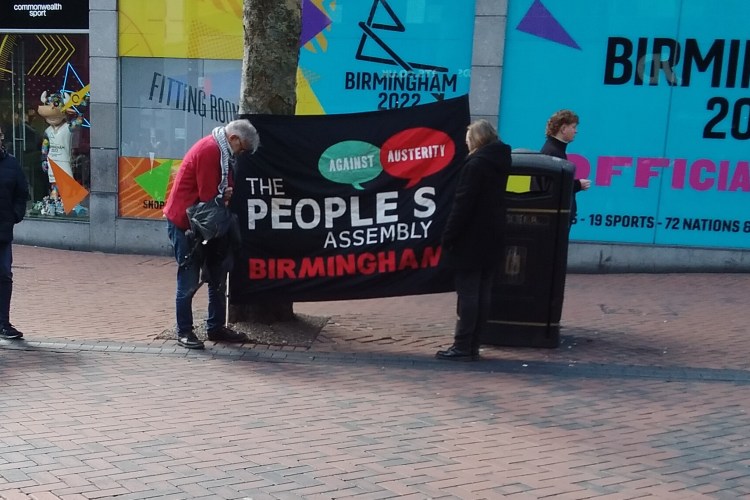
The People’s Assembly organised another round of protests against the rising costs of living in the UK (although of course, issues like inflation are not just affecting the UK). This included another Birmingham protest. The previous action took place on the 12 February, although there was also supposed to be an action on the 5 March. No one turned up to this action other than a few activists with tables (I have a couple of videos on my channel, see here).
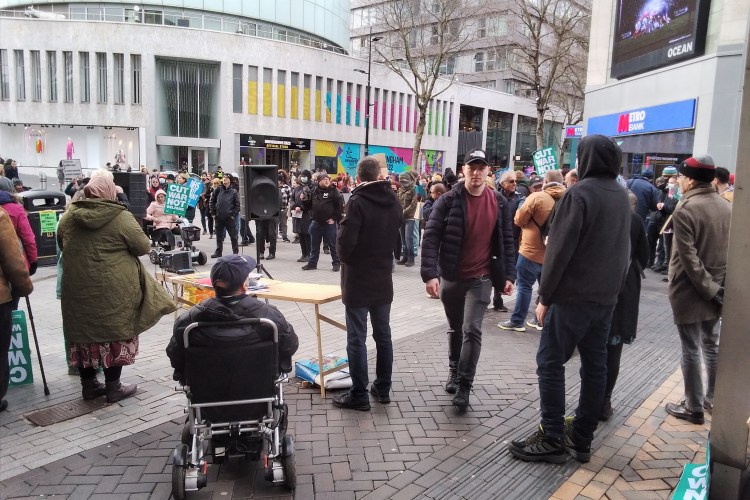
There was a larger selection of speakers at this event with a presence of a few hundred people. This included some people from the crowd as well as many union, climate activist, etc speakers that you would expect to appear at a bread and butter left wing event such as this.
Several unions were represented with the University and College Union and the Musicians’ Union as well as others. There were housing campaigners speaking as well as pensioners and climate activists (of course, there is a bit of a contradiction here with the fuel costs issue).
I thought the speeches at this one were a little bit better than the previous one, though there was some left wing/woke liberal nonsense involved in some of them, including references to Brexit (I really don’t get why anyone is talking about Brexit at this point) and the ‘pandemic’ and ‘Covid’ being the cause of things that were actually caused by lockdowns. For example, this speaker talks about the legitimate issues caused by lockdowns for jobbing musicians, but frames it as if it was caused by ‘the pandemic’ as some sort of disembodied entity not connected to government policy. So ultimately the root of the issue still was not attacked.
The Birmingham Stop the War leader Stuart Richardson also talked about the Ukraine issue and how that was affecting prices. Although placing sanctions on Russia will clearly exacerbate this issue I do not see it as a root cause, rather the government/elites will try to blame Putin for what they created. While any Russian retaliation is understandable in the context of sanctions the media will pretend it is all down to Putin being a ‘maniac’ and ‘madman’ (and hell, maybe Maddow was right about Russians wanting to freeze us to death?)
I spoke in my previous article on this issue about the difficulties relating to this issue of the cost of living, and I am still not sure how to resolve it:
I don’t want working class people to have to pay more money for energy bills etc., especially since they were the primary victims of lockdowns. I think that is fairly obvious. The question is how we tackle the problem. In general, even though I disagree with capitalist economics I have become a lot more sceptical of calling on the (capitalist) state to do anything about anything, since they will just use it to push more pain onto working people (a good example is the environment: while it’s clear that many things humans are doing are negatively affecting the environment, any state action is likely to be more authoritarian nonsense that will punish the working class like carbon based digital IDs). Unlike libertarians I believe that this authoritarianism is inherently interlinked with the capitalist system.
Alternative systems within the current one such as opting out as much as possible and doing other things within the freedom based community are a good idea. However, they are difficult to implement in practice given that people still have to survive within the current system (e.g. people have to go to work full time, leaving limited time and energy for alternatives). Such suggestions can come across as a bit naïve in some cases though I advocate them where realistically possible.
There is due to be further protests on the cost of living issue with a protest taking place on June 12 in London.
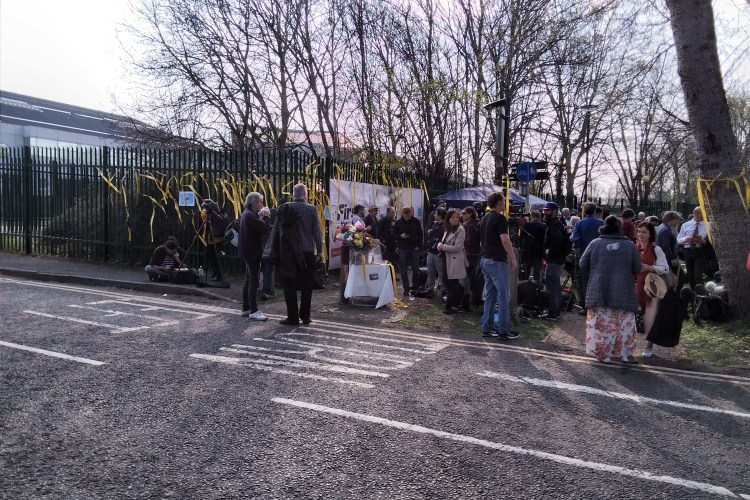
I was able to attend the Assange wedding celebration/protest outside Belmarsh prison on the 23rd March. I have some footage which I will post samples of below.
About 150 people turned up outside the prison.
The independent media people present (that I saw) were Craig Murray, Gordon Dimmack, Mohammad Elmaazi, and Resistance GB. Chris Hedges was also there which I wasn’t expecting.
Craig Murray spoke to some of the media (primarily Gordon Dimmack, see below) regarding his exclusion from being a witness at the wedding. Apparently, he was considered a threat to the prison by the British state:
Murray also talked about the meaning of the Assange wedding.
You can see the crowd in the video below:
The microphone was set up next to the tent. Julian Assange activist Truman read out some messages from worldwide Assange supporters.
After that there were more formal speeches. Chris Hedges gave a 13 minute speech that can be seen in this video where he talks about the collapse of the rule of law and the power of the ruling elite, as well as the need for mass civil disobedience:
Gordon Dimmack and Daniel Fooks were also invited up to give short speeches.
The police were mostly standing around looking bored and preventing anyone from getting too close to the prison. They would shoo people out of the road but that was about it. However, when ‘Lean on Me’ started playing through the stereo at around 3.40pm, the police decided to be extremely petty and turn of the music, claiming that it violated Greenwich by-laws.
After that the police started standing in the road and being more in your face about their presence. So that there was a line of 3-4 police keeping people on the street and not the road and generally trying to look more intimidating. I am not sure what the point was since before they turned the music off there hadn’t been any issues with the crowd but it seemed to me to be an exercise in willy waving from the officers.
The mainstream media is awash with feverish condemnations of Putin for invading Ukraine. Western governments and mainstream media are, of course, completely untrustworthy when it comes to any issue of foreign policy. In particular, prior to the Official Covid Narrative, they lied endlessly about Russia: Russia hacking emails to send them to Wikileaks, Russia swinging the election with Facebook ads, the bizarre Skripal psyop, and let’s not forget Russia freezing Americans to death. There have also been half assed attempts to maintain the Russia fear narrative throughout the Covid psyop: the Navalny narrative and the return from the dead of Boshirov and Petrov for one news cycle. In order to start to address this question, we have to be aware of the actual history of Ukraine, western intervention in that country, and how the US and NATO provoked Russia to act.
The Post-Soviet Space & Western Involvement: A Brief History
Ukraine became independent from the Soviet Union in 1991, as eventually the USSR became 15 different successor states. The largest of these is the Russian Federation, which existed in a state of shambles throughout the 1990s under the leadership of the alcoholic Boris Yeltsin. During this period Russia’s influence outside its borders massively waned as it was consumed with issues such as economic crisis, a rampant mafia, and possible further territorial losses in places such as the Caucasus.
The Western powers used this period to consolidate a bulwark against Russia by expanding NATO. The Baltic states – who always had more anti-Soviet/Russian sentiment – joined NATO in 2004 along with several other former socialist republics that were not part of the USSR. The other post-Soviet states remain outside of NATO, but there has been talk of trying to get certain other post-Soviet states (mostly Georgia and Ukraine) into the bloc.
The West has attempted to install and maintain anti-Russian, pro EU/neo-liberal governments in the post-Soviet states and former socialist republics, with varying degrees of success. This has involved the sponsorship of colour revolutions and the promise of EU integration. For example, the West opposed Shevardnadze’s government in Georgia (ousted in the 2003 Rose revolution) and Lukashenko’s government in Belarus (who they have tried and failed to oust several times, as recently as 2021).
The EU has also been involved in attempting to get 6 of the post-Soviet states to sign an Association Agreement. This plan was known as the ‘Eastern Partnership’ and started in 2009, targeting Belarus, Moldova, Georgia, Armenia, Azerbaijan, and most notably Ukraine. Some of these states, like Georgia, were fully on board, whereas others, such as Belarus and Armenia, were not (these countries preferred the Eurasian alternative promoted by Russia).
This initiative was portrayed by the EU as a technocratic and economic agenda, primarily about trade deals and reforms to make said countries more in line with neo-liberal ideology, such as deregulation. In reality such initiatives were designed to weaken Russia, the carrot to the regime change stick.
The ‘Euromaidan’ Coup, The Azov Battalion and The Donbass
The details of the Euromaidan Coup have been outlined in detail in multiple articles, both written at the time and more recently.
The Official Narrative of the Euromaidan is something like this. The corrupt, unpopular and pro-Russian Viktor Yanukovych was ruling over Ukraine. The EU reached out an olive branch to Yanukovych in terms of of an Association Agreement, a deal beneficial to both parties that would improve and modernise Ukraine’s economy and help to harmonise it with the EU. However, Yanukovych, after negotiating this deal, rejected it under pressure from Putin.
The Ukrainian people desired integration with Europe and were outraged by Yanukovych’s choice for Russia over the West. So they went into the streets en masse to oppose Yanukovych’s unpopular decision. His strategy of police brutality failed. Following this, his unpopularity led him to flee the country and to be replaced by a pro-European leader who was in line with the desires of the Ukrainian people.
Of course, there are massive problems with this narrative. It is true that that the (more Russian speaking) east of Ukraine supported Yanukovych much more than the west. He was elected in 2010 in replacement for the more pro-Western Yushchenko (I won’t get into the complications of the ‘Orange Revolution’ here). Ukraine is roughly divided on east/west lines politically, with the east being more pro-Russian and having more Russian speakers.
It is also the case that the failure to sign the Association Agreement acted as the trigger for regime change. After Yanukovych decided not to sign the agreement, protesters took to the streets. However, there are multiple divergences in reality from the official narrative:
Firstly, the association agreement was not as benign as it was originally portrayed. As Stephen F. Cohen points out: “[The agreement] included protocols requiring Ukraine to adhere to Europe’s “military and security” policies, which meant in effect, without mentioning the alliance, NATO.”
Secondly, the role of Neo-Nazis in the coup is brushed over, if mentioned at all by the Western media. There were multiple fascist groups involved with the protests, who idolise Ukrainian Nazi collaborator Stepan Bandera. These groups included Svoboda, a far right organisation led by Oleh Tyahnybok, and Right Sector.
Thirdly, the US government admitted spending “5 billion dollars ‘assisting Ukraine’. This includes 180 million dollars on ‘development programs’ for ‘judges, members of parliament [and] political parties’.”
Fourthly, the US Deputy Secretary of State at the time, Victoria Nuland, was also involved in maneuvering behind the scenes to ensure a government acceptable to Washington. Nuland met with the far right leader Tyahnybok personally. There is also a leaked call in which Nuland takes part, discussing how the government would be reconstituted after the coup, with Nuland identifying who should and should not go into government.
Furthermore, the situation in Donbass has been completely ignored by the mainstream media. The media acts as if Putin started a war in Ukraine, when there was already one: the shelling of the people of Donbass by the Ukrainian government. The people of Donbass rejected the coup in 2014 that massively increased the power of violent neo-Nazi groups, and instead formed the Donetsk & Lugansk People’s Republics.
Western governments and the mainstream media have misrepresented the situation in Ukraine in order to promote a pro-imperialist narrative. The situation in 2014 is directly linked to the current situation in Ukraine, which will be considered in further articles.
The British government, while currently appearing less authoritarian than some other Western governments due to the removal of many ‘Covid restrictions’, is seeking other ways to create a punishing authoritarian regime. Some of these I have already discussed, such as the Police Bill and the Nationality Bill, and others I have not, such as the Online Harms Bill (which seeks to ban ‘Covid misinformation’). One of the most important authoritarian moves is the reform of the Human Rights Act which has now been put out to consultation by the government. This article will look at the consultation and what is in it.
The Consultation Document
The Government has provided a document to read alongside the consultation. This document is extremely long and goes in to a lot of random detail. My guess is that the idea is to make the entire thing as intimidating as possible, so that people do not bother to respond. The questions (also listed on the page) on are also very technical and legalistic and so hard to understand. I’ve got to admit that I am not the best with legal jargon myself.
Fortunately there are already a couple of guides out there to help with filling in the consultation. It can be done via email or through an online link. The guides I have found so far for filling this in:
This one from Amnesty International. To make clear I don’t find them a trustworthy organisation due to their promotion of Western imperialism (including promotion of the incubator babies lie and the Douma false flag narrative).
This one from Save Our Rights, one of the organisations that has been active in opposing Covid totalitarianism.
Here are the questions copied and pasted from the UK consultation document. You’ll see what I mean about obtuse when you have a look:
Question 1: We believe that the domestic courts should be able to draw on a wide range of law when reaching decisions on human rights issues. We would welcome your thoughts on the illustrative draft clauses found after paragraph 4 of Appendix 2, as a means of achieving this.
Question 2: The Bill of Rights will make clear that the UK Supreme Court is the ultimate judicial arbiter of our laws in the implementation of human rights. How can the Bill of Rights best achieve this with greater certainty and authority than the current position?
Question 3: Should the qualified right to jury trial be recognised in the Bill of Rights? Please provide reasons.
Question 4: How could the current position under section 12 of the Human Rights Act be amended to limit interference with the press and other publishers through injunctions or other relief?
Question 5: The government is considering how it might confine the scope for interference with Article 10 to limited and exceptional circumstances, taking into account the considerations above. To this end, how could clearer guidance be given to the courts about the utmost importance attached to Article 10? What guidance could we derive from other international models for protecting freedom of speech?
Question 6: What further steps could be taken in the Bill of Rights to provide stronger protection for journalists’ sources?
Question 7: Are there any other steps that the Bill of Rights could take to strengthen the protection for freedom of expression?
Question 8: Do you consider that a condition that individuals must have suffered a ‘significant disadvantage’ to bring a claim under the Bill of Rights, as part of a permission stage for such claims, would be an effective way of making sure that courts focus on genuine human rights matters? Please provide reasons.
Question 9: Should the permission stage include an ‘overriding public importance’ second limb for exceptional cases that fail to meet the ‘significant disadvantage’ threshold, but where there is a highly compelling reason for the case to be heard nonetheless? Please provide reasons.
Question 10: How else could the government best ensure that the courts can focus on genuine human rights abuses?
Question 11: How can the Bill of Rights address the imposition and expansion of positive obligations to prevent public service priorities from being impacted by costly human rights litigation? Please provide reasons.
Question 12: We would welcome your views on the options for section 3: Option 1: Repeal section 3 and do not replace it; Option 2: Repeal section 3 and replace it with a provision that where there is ambiguity, legislation should be construed compatibly with the rights in the Bill of Rights, but only where such interpretation can be done in a manner that is consistent with the wording and overriding purpose of the legislation. We would welcome comments on the above options, and the illustrative clauses in Appendix 2.
Question 13: How could Parliament’s role in engaging with, and scrutinising, section 3 judgments be enhanced?
Question 14: Should a new database be created to record all judgments that rely on section 3 in interpreting legislation?
Question 15: Should the courts be able to make a declaration of incompatibility for all secondary legislation, as they can currently do for Acts of Parliament?
Question 16: Should the proposals for suspended and prospective quashing orders put forward in the Judicial Review and Courts Bill be extended to all proceedings under the Bill of Rights where secondary legislation is found to be incompatible with the Convention rights? Please provide reasons.
Question 17: Should the Bill of Rights contain a remedial order power? In particular, should it be: a. similar to that contained in section 10 of the Human Rights Act; b. similar to that in the Human Rights Act, but not able to be used to amend the Bill of Rights itself; c. limited only to remedial orders made under the ‘urgent’ procedure; or d. abolished altogether? Please provide reasons.
Question 18: We would welcome your views on how you consider section 19 is operating in practice, and whether there is a case for change.
Question 19: How can the Bill of Rights best reflect the different interests, histories and legal traditions of all parts of the UK, while retaining the key principles that underlie a Bill of Rights for the whole UK?
Question 20: Should the existing definition of public authorities be maintained, or can more certainty be provided as to which bodies or functions are covered? Please provide reasons.
Question 21: The government would like to give public authorities greater confidence to perform their functions within the bounds of human rights law. Which of the following replacement options for section 6(2) would you prefer? Please explain your reasons. Option 1: Provide that wherever public authorities are clearly giving effect to primary legislation, then they are not acting unlawfully; or Option 2: Retain the current exception, but in a way which mirrors the changes to how legislation can be interpreted discussed above for section 3.
Question 22: Given the above, we would welcome your views on the most appropriate approach for addressing the issue of extraterritorial jurisdiction, including the tension between the law of armed conflict and the Convention in relation to extraterritorial armed conflict.
Question 23: To what extent has the application of the principle of ‘proportionality’ given rise to problems, in practice, under the Human Rights Act? We wish to provide more guidance to the courts on how to balance qualified and limited rights. Which of the below options do you believe is the best way to achieve this? Please provide reasons. Option 1: Clarify that when the courts are deciding whether an interference with a qualified right is ‘necessary’ in a ‘democratic society’, legislation enacted by Parliament should be given great weight, in determining what is deemed to be ‘necessary’. Option 2: Require the courts to give great weight to the expressed view of Parliament, when assessing the public interest, for the purposes of determining the compatibility of legislation, or actions by public authorities in discharging their statutory or other duties, with any right. We would welcome your views on the above options, and the draft clauses after paragraph 10 of Appendix 2.
Question 24: How can we make sure deportations that are in the public interest are not frustrated by human rights claims? Which of the options, below, do you believe would be the best way to achieve this objective? Please provide reasons. Option 1: Provide that certain rights in the Bill of Rights cannot prevent the deportation of a certain category of individual, for example, based on a certain threshold such as length of imprisonment; Option 2: Provide that certain rights can only prevent deportation where provided for in a legislative scheme expressly designed to balance the strong public interest in deportation against such rights; and/or Option 3: provide that a deportation decision cannot be overturned, unless it is obviously flawed, preventing the courts from substituting their view for that of the Secretary of State.
Question 25: While respecting our international obligations, how could we more effectively address, at both the domestic and international levels, the impediments arising from the Convention and the Human Rights Act to tackling the challenges posed by illegal and irregular migration?
Question 26: We think the Bill of Rights could set out a number of factors in considering when damages are awarded and how much. These include: a. the impact on the provision of public services; b. the extent to which the statutory obligation had been discharged; c. the extent of the breach; and d. where the public authority was trying to give effect to the express provisions, or clear purpose, of legislation. Which of the above considerations do you think should be included? Please provide reasons.
Question 27: We believe that the Bill of Rights should include some mention of responsibilities and/or the conduct of claimants, and that the remedies system could be used in this respect. Which of the following options could best achieve this? Please provide reasons. Option 1: Provide that damages may be reduced or removed on account of the applicant’s conduct specifically confined to the circumstances of the claim; or Option 2: Provide that damages may be reduced in part or in full on account of the applicant’s wider conduct, and whether there should be any limits, temporal or otherwise, as to the conduct to be considered.
Question 28: We would welcome comments on the options, above, for responding to adverse Strasbourg judgments, in light of the illustrative draft clause at paragraph 11 of Appendix 2.
Question 29: We would like your views and any evidence or data you might hold on any potential impacts that could arise as a result of the proposed Bill of Rights. In particular: a. What do you consider to be the likely costs and benefits of the proposed Bill of Rights? Please give reasons and supply evidence as appropriate. b. What do you consider to be the equalities impacts on individuals with particular protected characteristics of each of the proposed options for reform? Please give reasons and supply evidence as appropriate. c. How might any negative impacts be mitigated? Please give reasons and supply evidence as appropriate.
The consultation allows you to only answer some of these questions and ignore others. To he honest I am going to ignore most of them and only focus on a few. I used the email method because I didn’t want to make arguments on the uber technical questions.
Questions 4/5/6/7: Free Expression
I looked at two bits that they mentioned in their consultation:
The government is committed to ensuring that the biggest social media companies protect users from abuse and harm, and in doing so ensuring that everyone can enjoy their right to freedom of expression free from the fear of abuse.
The government wishes to explore ways of strengthening the protection for freedom of expression in the Human Rights Act, mindful as always of the government’s primary duty to protect national security and keep its citizens safe.
Basically, ‘harm’ and ‘abuse’ can mean anything and ‘national security’ can also mean anything.
Question 8/9: Preliminary stages
These will be abused by the government to prevent cases they don’t like coming to court.
The examples that they gave on the consultation are very small uses of public money
Problematic to introduce this over a few frivolous cases, even if those cases lead to slight waste of public funds.
Question 22: Extraterritoriality
Concerns that they government will try to change this to prevent their soldiers being prosecuted for war crimes
Questions 26/27: Compensation
Deflects attention from the abuse and towards the individual making the claim
Divides the population into ‘good’ citizens worthy of rights and ‘bad’ citizens who are unworthy
Behaviour could mean anything such as attending a protest the government doesn’t like
May be used to discriminate against certain races, religions, etc. or against people who don’t agree with a state narrative e.g. the unvaxxed
General comments on the concept of a ‘rights culture’ and the public interest
See Naked Emperor’s post above on this one. Basically they are trying to put more emphasis on obligations to society. In other words another possible means to attempt forced injections in the ‘public interest’.
This was a protest organised by the usual suspects on the left, who to be honest I find generally tiresome at this point. This included the unions – Unite and the National Education Union – and the People’s Assembly. In other words, the lockdown fanatics that advocated for the situation we now find ourselves in regarding the economy – and those who mocked people like me for pointing out the devastation that lockdown would inflict on working people.
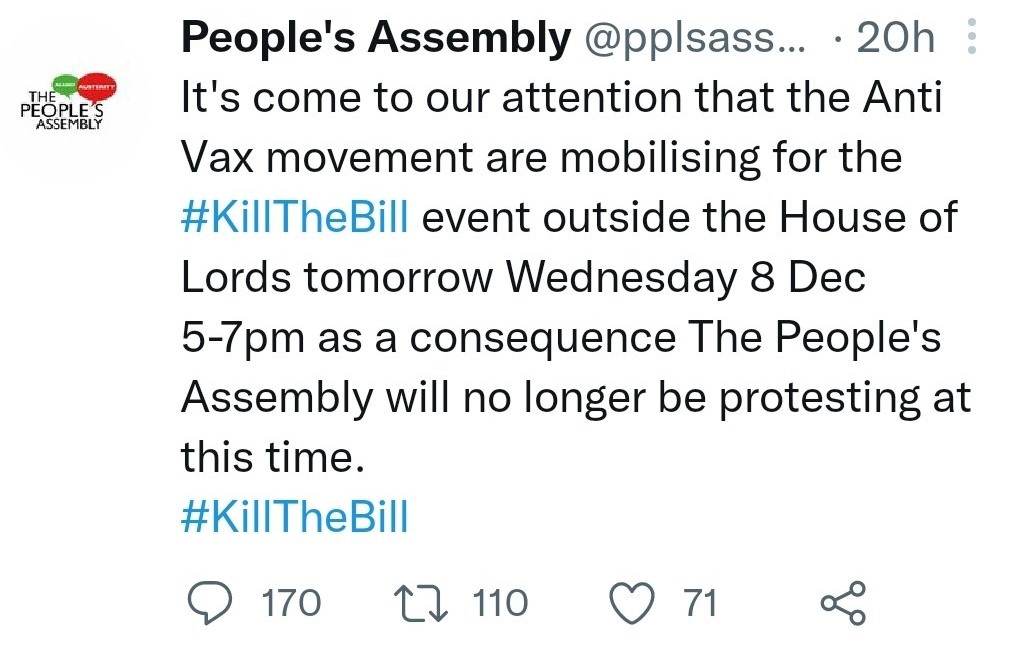
People’s Assembly even went so far as to refuse to protest alongside ‘anti-vaxxers’ against the draconian Policing Bill:
They later deleted this because of the backlash but here it is for posterity. As you can see it is a ratio’d tweet.
I primarily went to the protest in order to provide coverage of the event, rather than to take part. I have lost faith in the traditional and modern left to do anything useful due to their Corona fanaticism, advocacy for working class destroying lockdowns, harmful and useless (in terms of stopping viruses) face masks, and mocking and smearing anyone who even questions a dodgy Big Pharma product as an ‘anti-vaxxer’.
The framing that was present during the speeches is exactly what you would expect regarding Corona, complaining about the old staples such as ‘useless PPE’, ‘dodgy contracts’ etc., which does not get to the heart of the matter. The oblique framing of the ‘the Tories making us pay for the pandemic’ was present, but no mention of the horrific consequences of locking down and how it has harmed working class people. (The only speaker to use the word ‘lockdown’ was Nila from Stop the War coalition, from what I heard, which was not all of it due to wind noise).
Then we get the typical complaining about left wing bugbears such as Tommy Robinson (I believe he is only highlighting grooming gang victims to push a particular narrative, but the left has failed on this issue, see below), ‘The Tory government’ (as if Labour wouldn’t do the same thing), Brexit (as if this topic has any relevance to anything at this point and I say this as a Brexit/Lexit voter), etc. Though one of the speakers did call out Prince Andrew for being a pedophile and the royal family for protecting him, so maybe common sense hasn’t completely left the building.
I don’t want working class people to have to pay more money for energy bills etc., especially since they were the primary victims of lockdowns. I think that is fairly obvious. The question is how we tackle the problem. In general, even though I disagree with capitalist economics I have become a lot more sceptical of calling on the (capitalist) state to do anything about anything, since they will just use it to push more pain onto working people (a good example is the environment: while it’s clear that many things humans are doing are negatively affecting the environment, any state action is likely to be more authoritarian nonsense that will punish the working class like carbon based digital IDs). Unlike libertarians I believe that this authoritarianism is inherently interlinked with the capitalist system.
Alternative systems within the current one such as opting out as much as possible and doing other things within the freedom based community are a good idea. However, they are difficult to implement in practice given that people still have to survive within the current system (e.g. people have to go to work full time, leaving limited time and energy for alternatives). Such suggestions can come across as a bit naïve in some cases though I advocate them where realistically possible.
I have uploaded some of the footage onto my Bitchute channel of the speeches that were audible and not ruined by wind noise.
RE Tommy Robinson: Robinson wants to promote the idea that foreign or Muslim men are inherently a threat to women and girls, which is false (even though I do believe Islamic ideology to be misogynistic, it does not follow that all men from these backgrounds will rape children). However the left has ignored the grooming gang victims because they were victims of Asian men and that does not fit their own narrative of foreign/Muslim men not being a threat to women and girls. In reality a minority of men of all races are a violent threat to women and girls (which is one reason why we have separate spaces for women and men). Robinson ignores victims of white men, whereas the misogyny of the current left causes them to brush over the problem. The left also allows for more abuse of women and girls to take place by pushing transgender ideology, which states that any man is a woman if he declares himself to be so (including violent males). The women from Stand up to Racism claimed that their slogan involved justice for the victims, I wasn’t there so I can’t say, but there is no evidence of that in the signage.
Stand Up Wolverhampton organised a protest outside New Cross Hospital against the NHS jab mandate. As of the time of the protest the deadline for the first dose of the jab for NHS staff was February 3. (Since the protest took place the mandate has been paused, and so unvaccinated staff will not be getting the sack after 3rd February.)
I haven’t been to Wolverhampton in years and I ended up being late for this protest because the bus takes way longer to get there than it says it does.
I ended up being there between 1:40-3.
I didn’t know what to expect. Both sides of the street were lined with people when I arrived and they had the yellow flash cards on display. Apparently there had been previous actions in the Wolverhampton/Black Country area involving the placards. I know that the yellow placards have been used in other areas as well through the Rebels on Roundabouts activist group who have been asking questions about the jabs.
There was a really nice vibe to this protest. The artist Jaigo K was there doing some songs for the crowd.
I turned up in the middle of a song. I will post the clip of Jaigo K performing a song about the jabs below:
The speeches given focused on the jabs and the mandate and advice on the Yellow Card system:
There was also discussion about the Workers of England Union who are opposing the jab mandate. There was also a couple who stood up and talked about an example of poor care in the NHS. The event took place near the beginning of lockdowns and involved the daughter of this couple being treated with inappropriate drugs after going to hospital for an asthma attack.
This is a video of the crowd after the speeches took place with ‘Get Up Stand Up’ playing in the background to give you an idea of attendances at the protest: