A Brief History of British Antivaccinationism Part 4 – The National Antivaccination League – 1896-1972

Introduction

This series hopes to explore the history of British Antivaccinationism and Vaccine Scepticism.  It is divided into 7 main eras: the period of Inoculation, 1721-1798; the introduction of vaccination, 1798-1853; the imposition of mandates, 1853-1898; the remaining history of the National Antivaccination League, 1898-1972; DTP Vaccine Scepticism 1972-1998; Andrew Wakefield and vaccines cause autism, 1998-2019, and Covid 19, 2020 to present. This section will look at the resistance from ordinary people to vaccination during the late 19th century.

The Roots of the NAVL

The National Antivaccination League (NAVL) was founded in 1896. Its roots are in earlier organisations, such as Gibbs’ Anti Compulsory Vaccination League, started in 1866 in London. Afterwards, it became the London Society for the Abolition of Compulsory Vaccination, and then finally the NAVL.

Activities of the League – Publications

The League produced multiple publications over a period of years. They put out one regular publication called the Vaccination Inquirer and Health Review. This publication had started in 1879 by William Tebb and continued as the official publication of the NAVL.

The League also published a significant number of books questioning vaccination. These included books by many notable UK antivaccinationists, such as Maurice Beddow Bayly (who wrote on diphtheria and tuberculosis vaccines) J. T. Biggs (who wrote extensively on Leicester’s vaccination resistance) and Arnold Lupton (an MP opposed to vaccination).

Activities of the League – Advising Parents

The League gave advice to parents on how to avoid vaccination. One example in the Royal College of Surgeons archives, shows a leaflet produced by the League relating to the 1907 vaccination laws, which allowed conscientious objection. The leaflet showed specifically the steps to be taken to avoid vaccination.

Lily Loat – Tireless Antivaccination Activist

One of the key reasons for the successes of the NAVL was its secretary Lily Loat, who is one of the unsung heroes of historical antivaccinationism. She dedicated her life to opposing vaccination and was the secretary of the League for nearly 50 years.

Lily Loat joined the League in 1898, and became Secretary in 1909, and remained in that position until her death in 1958. She was a public voice of antivaccinationists, and also supported antivivisection causes. She also edited the Vaccination Inquirer.

She spoke at public meetings in both the UK and US. A couple of these addresses can be found via whale.to, where she discusses brain injuries caused by vaccination. Loat also wrote a book called The Truth about Vaccination and Immunisation, published in 1951. She worked for the League while sick with her final illness.

Lionel Dole, an antivaccinationist who wrote a book in the 1960s, mentioned Loat’s portrayal in the mainstream media:

The fact that she received no obituary notices whatever from our national newspapers was the highest compliment they could pay her. The only radio tribute to her great work was an oblique smear in a Granada TV serial. It showed two police officers looking with horror under a blanket at the corpse of an old woman recluse who had died of smallpox and who was said to have been a notoriously eccentric crank. Later in the episode, the junior officer remarks that at one time she had “actually started a league for the abolition of compulsory vaccination”; his Chief Inspector replies: “Oh, so it caught up with her!”

Oxford Dictionary of National Biography has a short biography of Loat, it requires a UK library card to access, and I am not sure if it is accessible in the US or elsewhere.

The End of the League

The Vaccination Inquirer ceased publication in 1972. One of the reasons for this was that the League struggled to replace Loat as secretary. Loat’s dedication to the movement was unmatchable.

Conclusion

The NAVL was the most notable organisation opposing vaccination in the first half of the twentieth century. Its demise in 1972 did not end British vaccine scepticism, however. In 1974 a paper would be published by Kulenkampff et al, showing brain injury from DTP vaccines. This would cause the DTP vaccination rate to plummet and begin a new vaccine injury movement.

Anti Digital ID Protest Birmingham 20 December 2025

This was the next monthly protest in the series.

On this occasion there were three main speakers, former Conservative politician Andrew Bridgen, David Icke, and Covid vaccine injured John Watt.

Former Conservative politician Andrew Bridgen

Andrew Bridgen spoke for about 4 minutes. The main theme of his speech was that digital ID is a one way street – once its introduced, it will be very difficult to get rid of. He said even if you are deluded enough to trust the current government, supporting digital ID is going to require trusting every future government. There is also a risk that the Labour government may come up with an excuse to cancel the 2029 general election. Digital ID is required for Agenda 2030, such as vaccine passports and carbon credits.

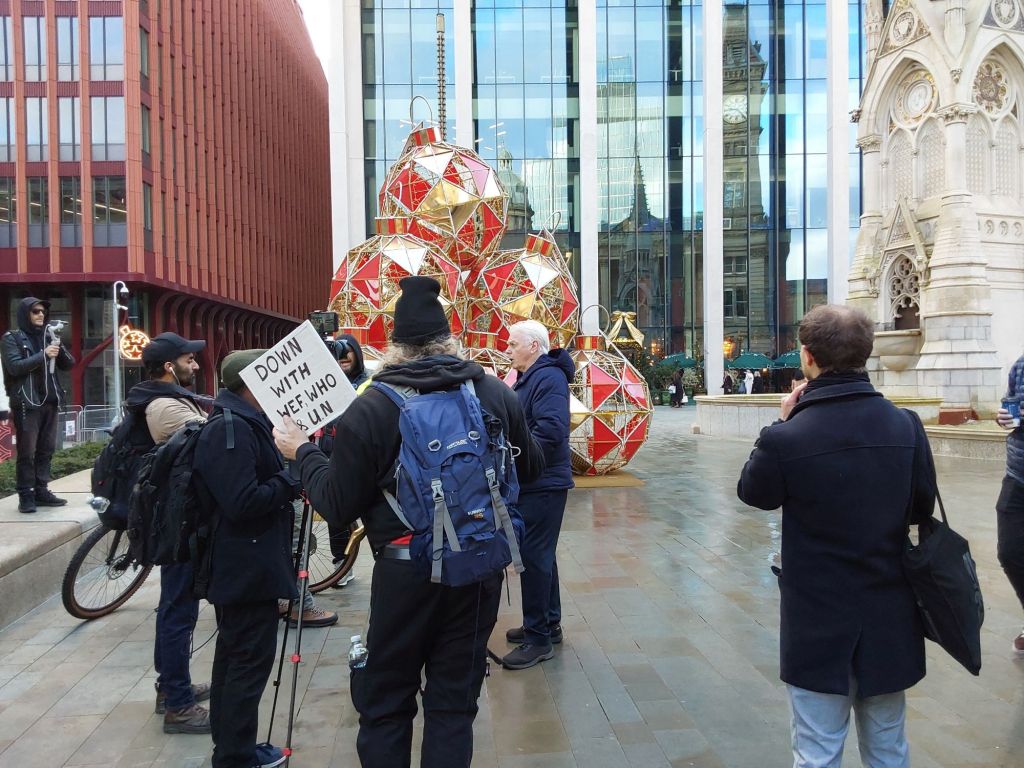
David Icke giving an interview in front of oversized Christmas baubles.

David Icke gave a long speech discussing what he called the global cult. There are similarities across countries due to the control over humanity by this global cult. The aim of this elite cult is to promote artificial intelligence and transhumanism as a means of control. The likes of Ray Kurzweil have made this agenda clear through their promotion of ideas such as the Singularity and the interlinking of AI and the human brain.

Elected politicians are deliberately idiotic and deliberately selected by the global cult to be do, so that people will be more willing to accept technocracy. They promote rigid belief systems and ideological conflict for control. Alternative media is too focused on issues like who killed Charlie Kirk, rather than exposing the real agenda.

It is better to remove the source of the problem rather than to talk about solutions. We need to stop believing in rigid belief systems as these are used for control.

John Watt spoke about the difficulties of getting help when injured by the Covid vaccine. It was good to see him give a speech since I believe at one point he was bedbound due to his injuries.

The next protest is 24th January. I will also cover that protest.

Anti Digital ID Protest Birmingham 8 November 2025

Man in a maroon shirt stands in front of a banner reading 'Say No to Digital ID'

There was another protest against the government’s Digital ID scheme on 8 November 2025. This was in the same location, Chamberlain Square, Birmingham.

Two people holding a banner reading 'Birmingham Rejects Digital ID, Freedom doesn't need a pass, we stand together'

There were fewer speakers at this event, instead there was some live music as well as speakers. Then there was a march around the city centre. They had also set up a TV screen partway through the march advertising the next protest.

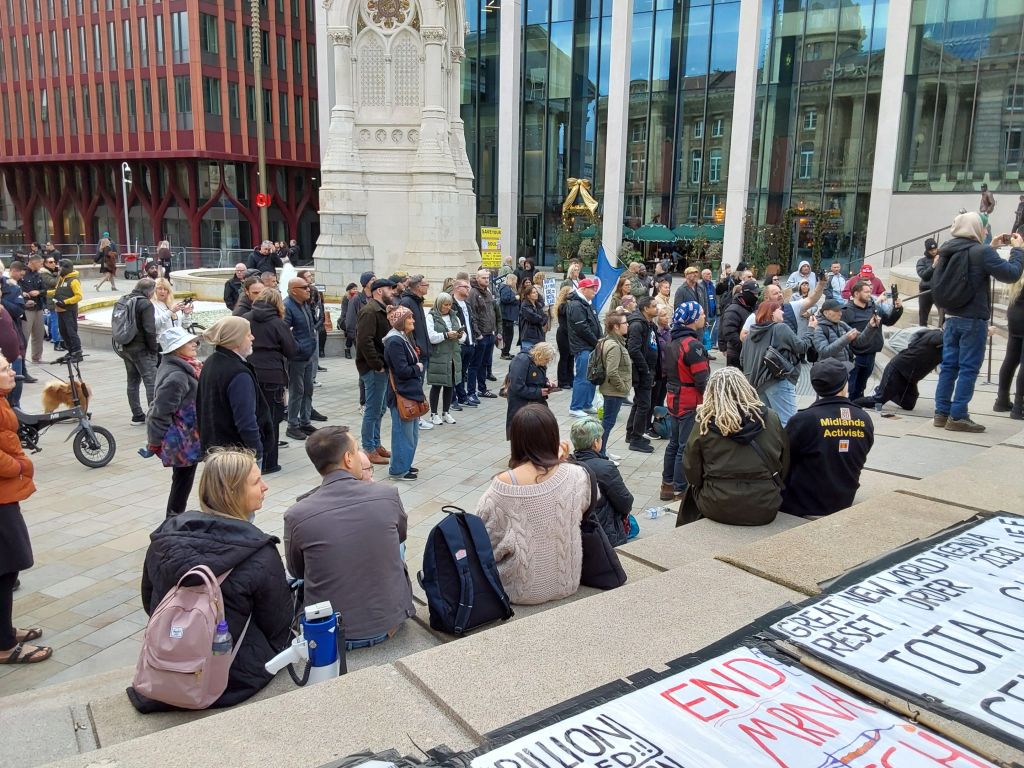
Crowd sitting on steps and standing at the bottom of steps in front of large water fountain

The crowd was a similar size to last time. The speakers included an Army veteran and Fiona from the Mass Non Compliance campaign. She gave a speech focusing on the government’s One Login and the international actors who are supporting tyranny such as the WEF.

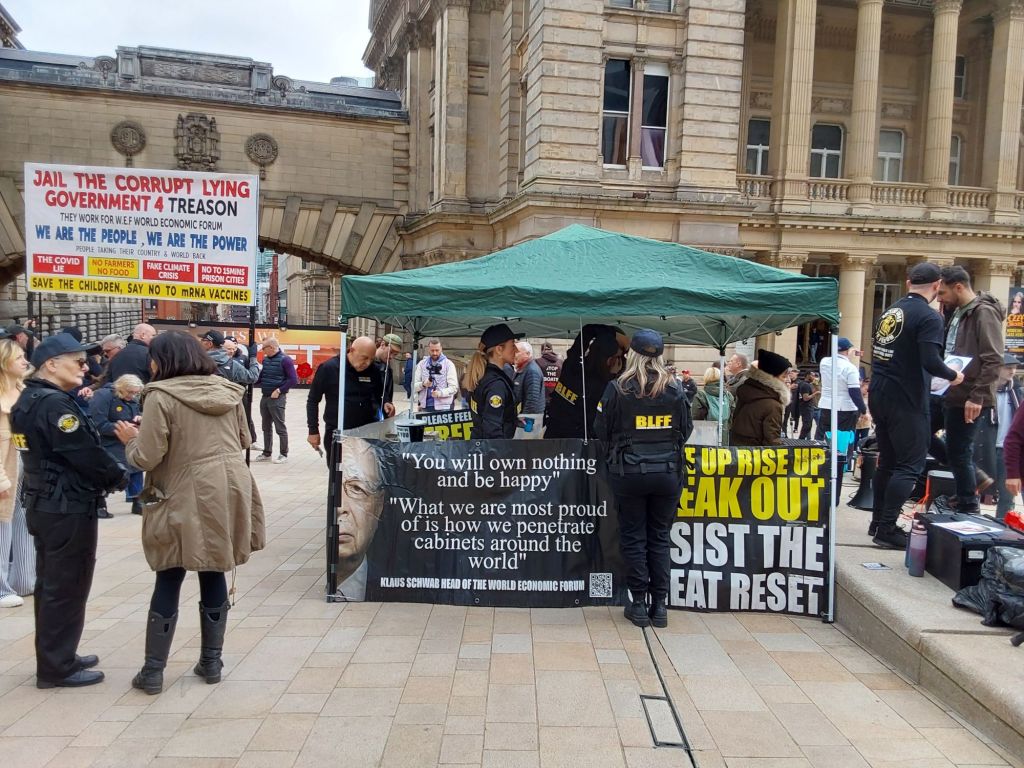
Booth giving out information with quotes from Klaus Schwab on a banner 'You will own nothing and be happy'

Some video footage from this protest and the last one has been uploaded to my YouTube account. As of yet it hasn’t been censored. I plan to upload the videos to Odysee as well but you have to reformat everything and I haven’t yet had time.

The next protest in Birmingham is 20 December 2025 with David Icke.

Starmer’s Digital ID Plan

Introduction

The UK government led by Kier Starmer has recently announced that they intend to introduce a Digital ID scheme. This article will look at the roots of this scheme in a UK context, the arguments they will be using to support it, and the reasons why this is a planned step towards government tyranny.

Background

Kier Starmer is the leader of the Labour Party and this particular party has a history of wishing to bring in national ID cards.

Under the Tony Blair government (1997-2010), there was a plan to introduce ID cards. In 2006, the Labour government passed the Identity Cards Act. This act was designed to provide biometric cards backed by a government database. These were physical cards (as smartphones etc were not in mass use).

The government did introduce a pilot scheme in 2009 for these cards where people could apply for them, and around 15,000 cards were issued.

However, the scheme faced significant opposition. There were some protests against the plan, as well as opposition from other political parties. Part of the opposition was based on the fact that any such scheme would be extremely expensive, and part of it was based on surveillance/police state concerns.

The scheme was scrapped by the Conservative/Liberal Democrat coalition government after they took power in 2010.

The New Scheme

The new scheme suggested by Starmer has been outlined in the mainstream media as follows:

  • It will include a name, date of birth, nationality or residency status, and a photo
  • You won’t have to carry IDs around
  • You’ll never be asked to produce it – other than when proving a right to work in the UK
  • The ID will be on people’s phones – similar to contactless cards
  • It will be compulsory for anyone looking to work in the UK

List taken from the BBC report on the ID card scheme.

Arguments

The main argument being used by Starmer to back his scheme is that digital ID will help to combat illegal immigration. Starmer is very unpopular in the UK at the moment and one reason is that people are dissatisfied with his response to small boat crossings of people illegally entering the UK, and ‘migrant hotels’ where migrants are kept while claims for asylum are looked at. As a result, poll results are showing a significant swing towards the anti immigration party Reform UK run by Nigel Farage. As such, he hopes to boost his popularity by announcing this scheme as well as normalise a plank of planned government authoritarianism.

The argument being made is that by having a Digital ID, it would make it more difficult for illegal migrants to work in the country, reducing the ‘pull factors’ that cause people to illegally enter the country. The government also argues that it will more quickly allow people to verify their identity when accessing government services such as welfare benefits to prevent fraud.

Problems

I don’t want to spend too much time outlining the issues of Digital ID as I think they are fairly obvious to my readers. One argument that has been made by some, that I would like to bring up, is the issue of whether it would work. Farage has criticised the scheme, partially on grounds that it would be ineffective. I personally think we shouldn’t focus on the effectiveness argument either way. We shouldn’t want Digital ID even if it was 100% effective against illegal migration.

The main thrust of any argument against Digital ID should be the state tyranny aspect. Once the infrastructure is established, there is nothing stopping creeping expansion of the scheme. Mahmood, the Home Secretary, has already agreed that this can/will happen. Digital ID can be linked to any aspect of life, for example, vaccination status, which the government could use to force people to behave in particular ways.

Conclusion

There has already been much concern from the public about the use of Digital ID. The scepticism towards the scheme must be mobilised as means to prevent further state tyranny. Hopefully the unpopularity of the Starmer government combined with resistance to the scheme can prevent it ever being introduced.

A Brief History of British Antivaccinationism, Part 3.2: White, Creighton and Crookshank

Introduction

This series hopes to explore the history of British Antivaccinationism and Vaccine Scepticism.  It is divided into 7 main eras: the period of Inoculation, 1721-1798; the introduction of vaccination, 1798-1853; the imposition of mandates, 1853-1898; the remaining history of the National Antivaccination League, 1898-1972; DTP Vaccine Scepticism 1972-1998; Andrew Wakefield and vaccines cause autism, 1998-2019, and Covid 19, 2020 to present. This section forms part 3.2 looking at three main antivaccinationists active in the late nineteenth century, William White, Charles Creighton, and Edgar Crookshank.

William White

White authored a book called Story of a Great Delusion in 1885, looking at the history of inoculation and vaccination from an antivaccinationist perspective. It covers the entire period from the introduction of inoculation up to what was then the present day.

The book is primarily a historical account and he goes into detail not just about Jenner but the research of other important vaccinationists, such as George Pearson, another notable doctor, and William Woodville, doctor at the Smallpox Hospital in London. It explores their tense relationships and goes into more detail about Jenner’s personality (he had a significant habit of falling out with those who mostly agreed with him).

He also goes into the history of the government role in vaccination, such as the provision of vaccine lymph by the National Vaccine Establishment, and how £3,000 was budgeted for lymph, as an attempt to spread vaccination among the poor. He argues that Jenner’s ability to argue with everyone was one factor why government intervention was necessary to ensure the continuation of vaccination, rather than a reliance on private institutions.

He covers the introduction of the vaccine mandate – essentially the increasing intertwining between vaccination and government – and the introduction of ideological vaccine resistance, such as the founding of The Anti Vaccinator pamphlet by John Pickering.

Throughout the book he does make some arguments explaining why vaccination is a flawed practice, such as that it simply exchanges one disease for another while not decreasing death rate and that vaccine compulsion is purely about medical industry profit, rather than effectiveness. White believed the ineffectiveness of vaccination had been well demonstrated by the mandate introduction in 1853.

Charles Creighton

Dr. Creighton was a physician of note in the late nineteenth century, who completed a famous work on the history of epidemics in Britain. He was primarily interested in medical history rather than being a practicing doctor.

The story of how Dr. Creighton became an antivaccinationist is rather interesting. He was approached by the Encyclopedia Britannica to write an article on ‘Vaccination’ for their new edition. Feeling it was only justified to research the topic if he was going to write about it, he did – and became an ardent antivaccinationist. Perhaps surprisingly, the Encyclopedia agreed to publish whatever he wrote, so that edition ended up containing an antivaccinationist account.

He wrote two books condemning vaccination in 1887 and 1889.

His book Cowpox and Vaccinal Syphilis goes into great detail on the topic of vaccine lymph. This included the historical disputes between Jenner and Woodville, and whether the two sources were equivalent. Jenner had issues obtaining cowpox lymph for vaccination, and this whole issue tied into the debate about ‘spurious cowpox’, which was one of Jenner’s excuses for vaccination failure. The primary argument in the book in terms of the dangers of vaccination is that cowpox is completely unlike smallpox, and is actually closer to syphilis (which was historically known also as ‘great pox’). There had been an increasing number of deaths from infantile syphilis after the vaccine mandate was introduced. In Creighton’s view, cowpox was causing this syphilis increase.

Jenner and Vaccination is a more general work on vaccination as a whole. He argues that Jenner used sleight of hand to redefine cowpox as variolae vaccinae (which literally means, cow smallpox). This manipulation led people to accept similarities between the two diseases that did not exist. Jenner also defined cowpox as a mild disease despite significant issues of ulceration to gain support for vaccination. He also argues that because Jenner used a very mild form of inoculation (deliberate infection with smallpox) to ‘test’ whether or not the vaccinated had immunity, this led to false claims of immunity. The mild (known as Suttonian, after Daniel Sutton) method of inoculation caused only a small effect anyway, so it having little to no effect after a cowpox inoculation proved nothing. He also mentioned the redefinition of smallpox as chickenpox after vaccination to avoid accusations of vaccine failure.

Creighton became involved in the National Anti-Vaccination League, and ended up being excluded from the mainstream medical community.

Edgar Crookshank

Crookshank published two volumes addressing vaccination in 1889. The second volume is a compilation of essays about vaccination and varying vaccination experiments performed by its advocates. As such we will focus on the first volume as that contains Crookshank’s actual arguments.

History and Pathology of Vaccination makes several arguments. One of the most interesting is Crookshank’s analysis of Jenner’s two different versions of his original paper on vaccination. Jenner originally tried to publish a paper on vaccination in 1796 via the Royal Society, but they rejected the paper. Instead, Jenner published the paper himself in 1798. There are significant differences between the two. Jenner did add more experiments and cases in an attempt to bolster his argument (the original paper had only contained the vaccination of James Phipps, one case). He also sought to tone down the negative effects of cowpox in the new paper, and attribute issues with the disease as incidental effects not directly caused by cowpox/vaccination.

A second argument made by Crookshank is to discuss all the different sources that were used as vaccine lymph, explored further in this post.

Conclusion

This period was the height of Britain’s history of resistance to vaccines, and this included the number and intelligence of those resisting vaccination. There are many critics who I have not covered, also active during this time, such as William Tebb and Alfred Russel Wallace. But there was more than intellectual resistance – there was popular resistance from the working class, the topic of the next article in this series.

The UK Media is still promoting Transgender Activism

Introduction

A few months ago, there was a UK Supreme Court ruling that stated for the purposes of the 2010 Equality Act, sex is biological, and that woman and man in the legislation refer to sex and not gender identity. Despite this rare application of common sense in a UK Court, the media is still promoting transgenderism as a desirable ideology.

Context

In a world context, the UK has had the strongest and broadest base of resistance to transgender ideology. People of different political views from conservatives to radical feminists to moderate liberals have pushed back. Both religious people and atheists have pushed back. This has led to the UK becoming known as TERF (trans exclusionary radical feminist) Island, originally meant as an insult but reclaimed as a point of pride by UK opposition to transgender ideology.

While there has also been increasing pushback in the US under Trump, much of it is based on executive orders. Executive orders that prevent a child being prescribed dangerous drugs and surgeries have a great positive effect in general but are not the same thing as the broad based opposition we see in the UK. Also, they can be overturned with a new president. In other western countries, we are still seeing victories for the transgender movement such as Self ID in Germany.

However the UK media has (deliberately) not got the message that this ideology is increasingly unpopular here. I will describe some examples below of the media doing this. Of course because these are long term projects they were commissioned before the Supreme Court ruling but still provide valuable insights into the media and this ideology.

Case 1: Munroe Bergdorf

Munroe Bergdorf is a man pretending to be a woman, who is relatively high profile in the UK.

I won’t go into his history in massive detail, but I will note that he has previously been heavily criticised for demonising all white people as violent and evil. He once said:

Once white people begin to admit that their race is the most violent and oppressive force of nature on Earth… then we can talk.

In other words, ignoring the fact that psychopathic elites and pursuit of wealth and power regardless of race are the sources of imperialist violence and instead blaming white skin colour.

Anyway, he has a new documentary out, about what else – himself. The documentary is called Love and Rage, and no, I won’t be watching. If you want a review, you can see this link.

In a promotion for this documentary, he did an interview with the ‘Metro’ newspaper. This is a free newspaper given out primarily via public transport networks. I take a copy for the cryptic crossword and happen to see this interview in the paper. Quotes and comments are based upon the interview “60 Seconds with Munroe Bergdorf” in the Friday, 4 July issue of the paper.

Much of the interview is just fluff to promote his film. However I will comment on a few things he says in the interview. One of them is to complain about being attacked on social media. Of course, since one of the main outlets for promoting transgenderism is social media, this is mildly amusing. He then equates refusing to acknowledge he is a woman with refusing to acknowledge he is a human being. Of course, even the most ‘transphobic’ person on the planet acknowledges that Bergdorf is a human being – just that he happens to be male and cannot change sex.

He then promotes falsehoods by stating that the Supreme Court ruling “has basically defined us out of the Equalities Act”. He doesn’t acknowledge that one of the nine categories under the act is “Gender Reassignment” i.e. transgenderism. Of course he can’t even get the name of the legislation correct, as it is the Equality Act, which demonstrates his complete ignorance. Now from my point of view (without getting into broader questions of the state, state authority etc.) transgenderism should not be protected in law because it is a sexual fetish (autogynephilia) and/or a sexual strategy (gay men who ‘transition’ to try and get ‘straight’ men to sleep with them). No other sexual fetishes are protected in law.

He states he will continue to be a sexual pervert and use women’s toilets and complains that ‘if you look too much like a woman’ you can’t use the men’s. Ignoring the fact that in reality, 99.9% we can tell you’re a man. Women are generally quite good at spotting them as we have to be alert to the presence of men due to sexual violence. Or as I like to say Instagram filters do not exist in real life.

That’s not all the nonsense in the interview but serves as a sample of the sort of thing being promoted in the mainstream media

Case 2: The “I Kissed a Boy” Dating Show

‘I Kissed a Boy’ is a supposedly homosexual dating show for gay men. Now I don’t watch this sort of stuff as I have no interest in it. But it came to my attention because this dating show supposedly for male homosexuals includes a woman among the cast, who calls herself Lars and pretends to be a man. Of course, these women are not homosexual males. A significant motive for this is sexual fetish, as women fetishise gay male relationships specifically, which is why they seek to be accepted as ‘gay men’. Some of these women even try and trick/pressure gay men into sex with them.

This follows the trend of seeking to redefine homosexuality as ‘same gender’ attraction rather than same sex attraction. (Of course, this also redefines heterosexuality as ‘opposite gender attraction’). Basically this dating show continues to push the ideology that people can change sex and the lie of gender identity.

From the review, it seems like the entire thing is about sex. Of course while sex and sexuality are important parts of becoming an adult it’s hardly the only thing of relevance.

Case 3: “What It Feels Like for a Girl” TV Show

A BBC TV show with this name, of course, is about a male. It is adapted from a book of the same name by a man called Paris Lees. I haven’t read the book or watched the TV series so I won’t be doing a review. Lees, like Bergdorf, is a homosexual male who pursued transgenderism. The book/TV show is meant to be a ‘coming of age’ style story where the protagonist discovers his sexuality/’gender identity’.

The Lies They Tell gave the book (which was released in 2021) the following review:

This book is simply terribly written.  Writing in dialect would be a challenge for an experienced writer and it says a lot about Lees’ ego. However, even if you take the dialect away, all we are left with is the relentless gossipy sniping of a man with almost zero ability for self-reflection.  It’s really hard to read. It has no narrative arc.

The program, of course, is getting rave reviews from the usual suspects, such as the Guardian, a liberal UK newspaper known for promoting transgender ideology.

On a final note, I always find these men calling themselves ‘girls’ entirely creepy.

Conclusion

Transgender ideology is still a prominent force in the UK media despite the recent high-profile defeat in the court system.

A Brief History of British Antivaccinationism Part 3.1 – Initial Opposition to the Smallpox Vaccine Mandate

Introduction

This series hopes to explore the history of British Antivaccinationism and Vaccine Scepticism.  It is divided into 7 main eras: the period of Inoculation, 1721-1798; the introduction of vaccination, 1798-1853; the imposition of mandates, 1853-1902; the remaining history of the National Antivaccination League, 1902-1972; DTP Vaccine Scepticism 1972-1998; Andrew Wakefield and vaccines cause autism, 1998-2019, and Covid 19, 2020 to present. Because most active resistance to vaccination is clustered in this period between 1853 and 1902, Part 3 will have three sub-parts, discussing initial intellectual resistance in John Gibbs and Charles Pearce, the later intellectual resistance of William White, Charles Creighton, and Edgar Crookshank, and popular class resistance.

The Vaccine Mandate

In 1853, the United Kingdom introduced mandatory smallpox vaccination.  There was a fine of 20 shillings introduced for non compliance. William White covers the introduction of this mandate in detail in his 1885 book, Story of a Great Delusion. According to White, the mandate was introduced because of the organised interests of the medical profession. There was a lack of discussion on the bill in Parliament, and White states it was an “act for application to the vulgar”, i.e. the working classes. In 1861 and 1867, the level of compulsion was increased, the 1867 amendments made non vaccination a continuous offense and gave the state the power to impose multiple fines.

Prior to the mandate, there was no organised antivaccinationism. There was personal distrust of vaccination among people, particularly the working class, and an apathy of not pursuing vaccination. The mandate triggered new wave of intellectual antivaccinationism, as well as popular vaccination resistance.

John Gibbs

John Gibbs was one of the first to write pamphlets against the vaccine mandate. In 1855 he wrote a letter opposing the mandate. He argued that the mandate was an attack on liberty, and that legislators freely admitted their ignorance on vaccination – relying only on the opinions of the medical profession to pass the bill. He argued that there were statistical issues with the case for vaccination, as there was evidence that smallpox was simply replaced by other causes of death and that there was no decline in the death rate due to vaccination. He also pointed to other diseases spread by vaccination,  such as erysipelas (a form of skin rash and swelling), tuberculosis and syphilis.

He drew attention to the moral issues with government forcing a medical intervention on the people and that this opposed self responsibility. Vaccination was in his view “a state religion in physic”.

Charles Pearce

Charles Pearce was an editor of a medical journal, who received papers from Gibbs, and as a result became an antivaccinationist. In 1868, he authored the short book, Vaccination Its Tested Effects, arguing that “vaccination is a crime against nature”.

Pearce points to the theory behind vaccination, that is the idea that cowpox and smallpox are “governed by the same laws” as an error believed by Jenner. He argues that vaccination is not even practised according to Jenner’s theory, since Jenner believed in a chain from horse-cow-human. Vaccine lymph had been spread from human to human for many decades at this point, and had not been anywhere near passage via a cow. He also pointed to the introduction of revaccination as a contradiction to Jenner’s theory of life long protection from vaccination.

He argued that smallpox vaccination did not save lives, by arguing that smallpox increased longevity if you survived, by the fact that there was an increase in mortality from measles after compulsory vaccination was introduced, and that smallpox vaccination could spread syphilis. He points out that there were ups and downs in smallpox due to the laws of epidemics. He believed sanitation and hygiene were the best methods to combat smallpox mortality.

Conclusion

There was increased intellectual resistance to vaccination after the smallpox vaccine mandate was introduced. This would continue to develop further, and British antivaccinationism would reach its peak between 1880-1902 with the cases made by William White, Charles Creighton and Edgar Crookshank against the practise.

Free Lucy Letby Protest Part 2 – The Protest and Narratives

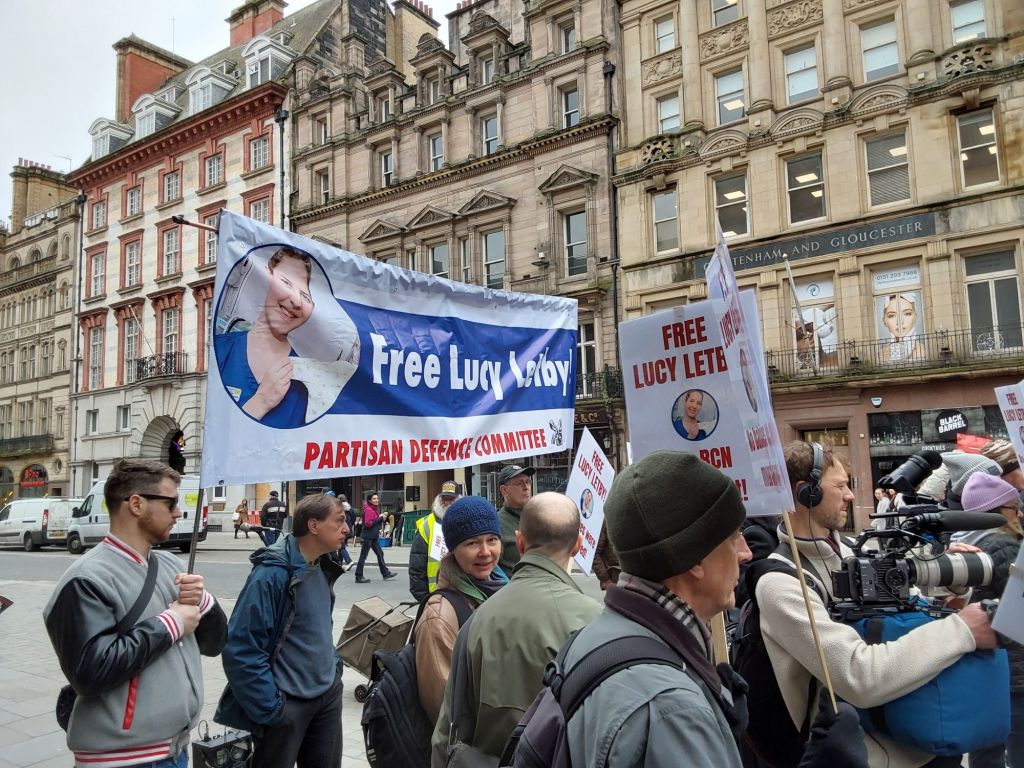
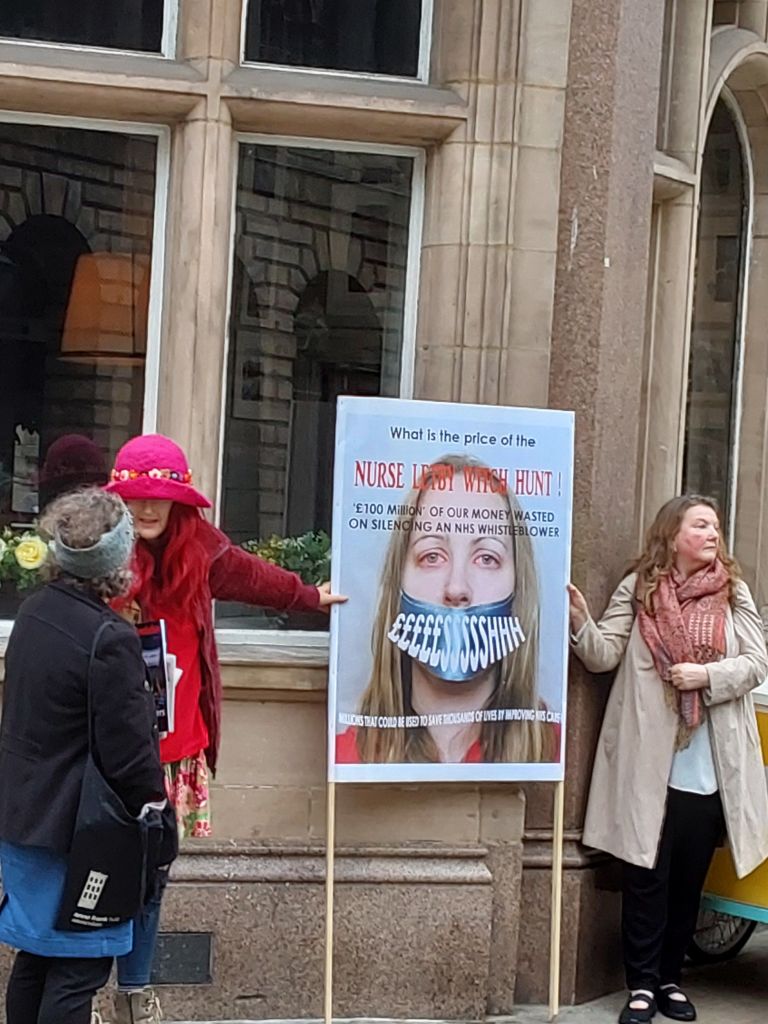
On 17th March 2025, a protest took place in Liverpool outside the Thirlwall Inquiry stating the innocence of a nurse, Lucy Letby, who has been convicted of murdering several babies. For the problems with the case against Letby, see Part 1.

The Protest

The protest took place between 9 and 10am outside Liverpool Town Hall. The protest was called by the Spartacist League, which is a UK Trotskyist group. While the protest was called by this group, they explicitly stated in their promotion of the protest that anyone who agreed with the message of Free Lucy Letby could/should attend.

I don’t know how many attendees were affiliated with this group. There were only a few attendees at this event (less than 100) so I would guess the majority are Spartacist League members.

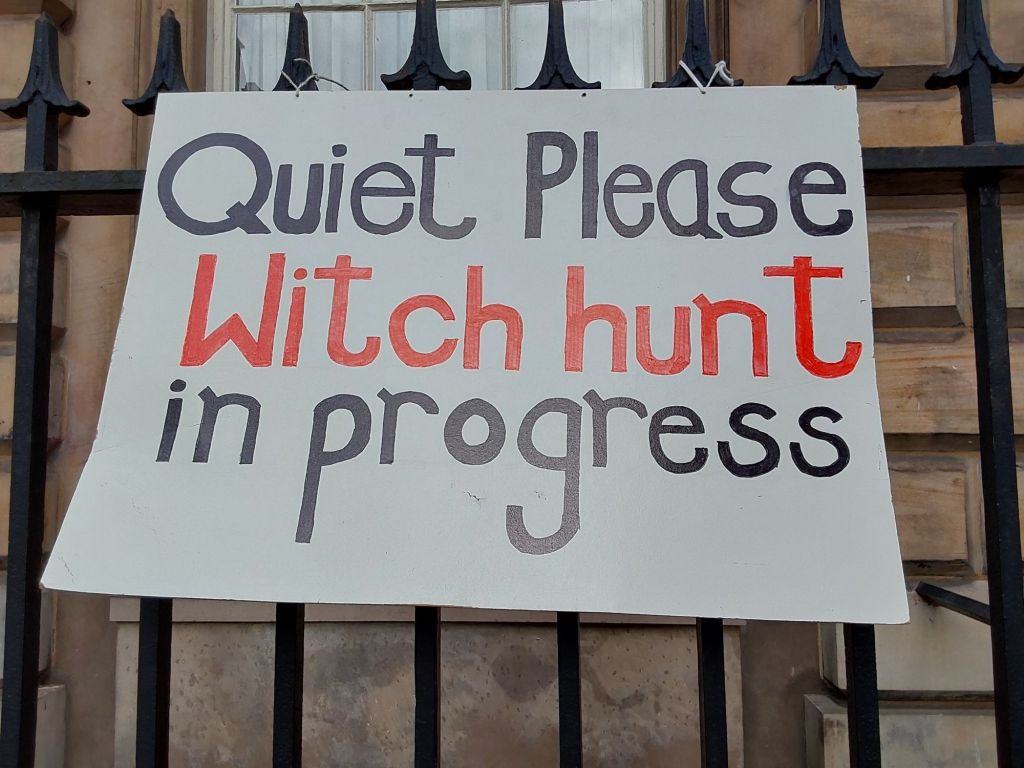
Sign tied to Liverpool Town Hall

The Spartacist League, because they are a Marxist group, have a particular spin on things. Marxist groups, by and large, believe that even a capitalist/bourgeois state can provide important concessions to the working class and that these concessions are worth defending. (At this point in my life, and I confess I have thought differently in the past, I believe the only stance to take is that against anything that enhances state power and control on principle, and that radical decentralisation is the only possible means to prevent corruption).

As such, the framing put forward by the Spartacist League is that of a hard-working and competent nurse framed up for systemic failures, such as the sewage mentioned in Part 1. This is true as far as it goes, in that I do believe the Countess of Chester Hospital consultants and the police sought to scapegoat Letby for these failings by accusing her of deliberately murdering babies.

The Spartacist League links the failings of the NHS to the right wing agenda of reducing the amount of funding available to the NHS, which is why these failings exist. The League (correctly) sees Labour and the Conservatives as part of the same system (they both support the same key policies such as, say, imperialist wars).

Fundamentally, the League perceives the NHS as worth defending as an institution that provides health care to ordinary people free at the point of use and funded via taxation. The establishment sees the problem as an allegedly ‘rogue’ nurse such as Letby,  whereas the opposition sees the problem as the lack of funding and corruption in management. While corruption in power structures is a real issue, neither of these narratives examines the allopathic medical paradigm as an issue.

The Allopathic Paradigm

The allopathic medical paradigm is based upon two broad factors – the separation of Western societies from natural medical knowledge, and the rise of the chemical industries in the late 19th century (the root of the modern pharmaceutical industry).

Western populations were separated from natural medical knowledge via the phenomenon of the Witch Trials. Female healers, who served the interests of the people they attended, were viciously exterminated under the guise of the Church. While the Church’s aim was to increase its own power, the Witch Trials had the effect of eliminating any competition that could arise to the allopathic paradigm in Western societies.

The second factor, the chemical industry, came about as a result of the Industrial Revolution, particularly in Germany. This industry directly spawned the pharmaceutical industry. The pharmaceutical industry is the basis of the modern NHS, because although it is directly run by the state, it purchases all of its drugs via the pharmaceutical industry, and its treatments are mostly dependent upon this industry.

Returning to Lucy Letby, she was an operative within this particular paradigm, and an agent of such. Any (inadvertent) harm she did would have been as an operative within the paradigm itself. For example, her Wikipedia page states that:

[I]n April 2016, she administered antibiotics to an infant that was not prescribed them, which she misclassified as a “minor error”.

I would bet any nurse, doctor, etc. has done the same thing or similar, and if they have a long enough career, probably multiple times.

Anyone on those wards could have caused harm to those babies, through this kind of method, or through a drug harming a baby more generally. It is much more plausible that this happened, than the alternative of Letby as psychopathic baby killer.

One final point to make. The allopathic paradigm believes its control over nature is complete. The fact that these babies were highly vulnerable and would have been at high risk of death even with the best of intentions is ignored. This links directly to the ideological belief of absolute control over nature, which is fundamental to allopathic medicine.

Conclusion

I believe the murder charges against Lucy Letby are most likely unjust and that the conviction in this case is unsafe. I believe her defence lawyers did not present a good case for her innocence. There does need to be another trial in this case.

This should not be confused with believing that the allopathic medical system should be defended. Letby was a low-level operative within that system, who took the blame for its failings. She bears no more or less guilt than any other similar operative.

Free Lucy Letby Protest, Part 1 – Background

On the 17th March 2025, there was a protest in Liverpool outside the Thirlwall Inquiry. The protest was about stating the case for the innocence of Lucy Letby, a nurse who worked in the National Health Service (NHS) and was convicted of murdering several babies on a neonatal unit.

Liverpool Town Hall, the location of the Thirlwall inquiry

Context

Lucy Letby was a neonatal nurse working on a ward in the Countess of Chester Hospital. While she was working there, there was an above average number of baby deaths on the unit. When this was looked into, it was claimed that one particular nurse, Letby, was on shift for the suspicious baby collapses and deaths. As such, Letby was charged with murder and attempted murder, and was convicted in 2023. The case against her rested on circumstantial medical evidence presented by the prosecution.

The purpose of the Thirlwall inquiry was to examine why warnings about Letby were ignored and how she was allowed to act to kill babies.

Doubts about the Conviction of Lucy Letby

Many people – an increasing number – have been questioning the conviction of Letby. This includes even some mainstream examples.

I was first made aware of the weaknesses in the case against Letby by Norman Fenton, who you may be aware of, as he has questioned the official Covid narrative. The original reason for suspecting Letby was statistical, that is, she was on shift for the baby collapses and deaths. Fenton pointed out that the data was cherry picked, and that a similar chart could be made for any nurse by simply selecting the events that happened when they happened to be on shift.

Scott McLachan, who Fenton interviewed, has pointed to a plausible alternative explanation for the deaths. During the period that Letby worked there, the unit was handling very vulnerable premature babies. The building where the unit was housed also had very old plumbing systems, with a high probability of leakage. There was evidence of water contamination at the hospital and the death certificates of many of the babies included sepsis. There was also a high probability of natural death of these babies due to extreme vulnerability.

More recently, mainstream figures have questioned the case against Letby. David Davis, a Conservative politician, has stated there is a “high probability” that Letby is innocent. He argues that there is no evidence of murders in the accounts of the trial or transcripts, and that a large number of medical experts question the evidence presented by Dewi Evans, the medical expert relied on by the prosecution. Peter Hitchens, a Mail on Sunday journalist, has also expressed doubts about the case.

Motives for Blaming Lucy Letby

There are several motives to blame Letby for the baby deaths. The hospital was clearly unsanitary, and they were treating very vulnerable babies. As with everything else, there is always the tendency to blame someone low down the food chain, rather than consultants, doctors, or top-level managers. Only nurses were mapped on the statistical chart used against Letby, but if there was a murderer on the ward, why not consider the doctors as equally possible culprits?

It is worth noting that Letby was charged in November 2020, which was still in the middle of the ‘Covid pandemic’ narrative, if not quite the peak. During the ‘pandemic’, the NHS was glamourised, and a failing ward such as we observed at Countess of Chester Hospital would not have fit with that narrative. There is one further critical question to ask: what if Letby is simply a scapegoat for failings of the allopathic medical system?

Conclusion

It is unlikely that Lucy Letby consciously killed babies as some sort of psychopathic thrill, as alleged by the prosecution. The second part of this article will be a more critical follow up, covering the protest itself, the framing of the narrative put forward by the protest organisers, and the flaws of that framing. We will also return to critical questions of guilt within the allopathic medical paradigm, and how all practitioners are embodiments of that guilt.

Yes, they are still abusing disabled people in the name of the ‘pandemic’

Back in February 2023, I wrote about a case from Jersey, where a severely autistic man injured by the MMR vaccine was being forced to take the Covid vaccine against the will of his parents. He was too severely autistic to make his own decision regarding the vaccine. The care home where he was living had denied him certain activities and essentially kept him in isolation from the other residents because he was not vaccinated.

Even earlier than this case, there were multiple examples of DNRs (Do Not Resuscitate orders) being put on people with learning disabilities as a blanket policy.

Now there is a new horrific case of a severely disabled man being abused by the system being reported.

Amother has launched a legal battle to stop the state from spiking her Down’s syndrome son’s drinks with sedatives so he can be jabbed with the Covid vaccine, The Telegraph can reveal.

Cups of tea and glasses of orange juice have been secretly laced with sedatives to subdue the man, in his thirties, so he can be given the vaccine and booster jabs.

I don’t have words for how utterly disgusting and repulsive this is. The people doing this are either psychopaths, or so sick in the head off the high of vaccinationism that they cannot even comprehend moral values any more.

Despite all the side effects of the covid vaccine, they are still pushing the ‘benefits outweigh the risks’ narrative as a justification to push the vaccine.

Here is a description of how the forced sedation was carried out from the above article.

As a “thank you” for having a mug of breakfast tea and a glass of orange juice brought into his room, Adam invariably hugged the staff he trusts so implicitly at his care home.

Unbeknown to him, on five separate occasions over the last 16 months those drinks were laced with a “covert anxiolytic medication” – a powerful sedative. Twice he became groggy before eventually succumbing to a deep sleep.

Each time, a team of senior carers, a nurse and the home’s manager stood quietly outside the room awaiting the nod to enter. One of them was armed with a syringe – kept well hidden due to Adam’s needle phobia – loaded with the Covid vaccine.

When the sedatives worked, Adam’s sleeve was quickly rolled up, the antiseptic wipe swiped over his upper arm and the needle inserted deep into his muscle as the plunger was pressed emptying the syringe barrel of its viscous contents. One carer made copious notes in readiness for a report which would be sent to the Court of Protection explaining how the procedure had gone.

The article further states that when Adam was given information relating to the vaccine, he said no to the vaccine.

The mother of this man is trying to fight them doing this to him again, so she is taking these disgusting individuals to court. She has a CrowdJustice campaign currently active for the legal fees.

The only conclusion I can draw from the evidence is that disabled people are not safe in any of these government institutions.