The Dark Side of Polio Vaccine Testing

Introduction

Polio vaccines are hailed as a heroic development in medicine and science. However, there is a dark side that is less acknowledged, at least in the media accounts of the polio vaccine. This is the abuse of disabled people – specifically disabled children in institutions – by vaccine testers.

How the Sausage was Made

Most polio vaccine development took place using monkeys. Jonas Salk, who created the inactivated polio vaccines, used rhesus monkeys imported from India extensively. In fact, this import of monkeys was a minor industry. This testing had involved infecting multiple monkeys with the virus, particularly when Salk had been involved in attempting to discover the amount of different strains of poliovirus. It also involved extraction of the monkey kidney tissue, in order to create a cell culture to grow the virus to create the vaccine. It was required to keep killing monkeys to gather this tissue because immortal cell lines, such as the HeLa line (an immoral exercise in lack of informed consent and medical racism in itself) had not yet been created when the polio vaccine was being developed. This cell line would only come to be used in a limited way during the testing phase.

However, Salk and other vaccine testers needed to move their vaccine testing from primates to humans, before the full scale testing that would take place among the general child population. For this exercise, they selected children in institutions as the first target for human vaccine testing. As quoted in the article Between Simians and Cell Lines:

The transition from experiments with imported non-human primates to trials with ‘normal’ American children was conceptually bridged via the testing of institutionalised disabled humans deemed non-normal.

Let’s take a closer look at the three main vaccine developers at this time, Jonas Salk, Albert Sabin, and Hilary Koprowski, and how they used disabled children in their vaccine experiments.

Jonas Salk

Jonas Salk, while testing his inactivated polio vaccine, carried out two rounds of testing on disabled children. He carried out work at the D T Watson Home for Crippled Children and the Polk State School. This testing took place in 1952, prior to the main testing of the Salk vaccine in 1954:

At Polk, Salk first inoculated children who were already polio victims with a vaccine derived from the same virus type present in their blood to assess their immune response. Following this, he vaccinated other children who had not previously contracted polio and who lacked protective antibodies.

There is no even hypothetical benefit to these children if they had already had polio. 

Albert Sabin

Albert Sabin, in contrast to Salk, developed a live attenuated virus polio vaccine. When he wanted to test his vaccine, he applied to carry out an experiment at the Willowbrook institution. Willowbrook was a home for disabled children notorious for abuse and other unethical experiments, primarily hepatitis experiments. It was exposed in the 1970s by investigative journalist Geraldo Rivera.

However Sabin’s application to test his vaccine there was refused, and he turned to prisoners to test his vaccine instead.

Hilary Koprowski

Hilary Koprowski is the least well-known of the three main polio vaccine developers in the 1950s. This is because his vaccine was not adopted. However, it was extensively used in some parts of Africa, particularly the then Belgian Congo around Leopoldville (modern Kinshasa).

Koprowski, like Sabin, believed only a live vaccine would be effective against polio. He thus worked on creating attenuated strains of the poliovirus.

In 1950, he gave the first live polio vaccine to a human being at Letchworth – a home for people with intellectual disabilities. In the articles published about the vaccine testing, the children given the vaccine were referred to as ‘volunteers’. One of these children had to be fed the vaccine via a stomach tube.

While working on further attenuated viral strains, he created his most notable polio vaccine strain, known as CHAT. He created this vaccine strain by attenuation the virus in various cell lines. However, he then used the disabled children at Sonoma institution to create the vaccine strain itself, by passing the attenuated vaccine strain via four children and extracting the virus from fecal matter. He called the vaccine CHAT, according to him, because it was a truncation of Charleton, who was the last child used in the creation of the strain.

He conducted further trials at Sonoma in 1955, including those to see whether his attenuated vaccine strains would spread to non- vaccinees. As stated on page 221 of Edward Hooper’s book, The River:

In the course of these he and Tom Norton, assisted by a phalanx of nurses, had conducted two contact experiments, in one of which a group of six children who had been fed SM [one of Koprowski’s strains] and who were excreting virus in their stools were kept “in very intimate contact” with another eight children who lacked Type 1 antibodies. In practice, this meant that for the next twenty days the children (all of whom were incontinent) were allowed to play together for three hours a day on a plastic mat, which, although it was washed down to prevent its becoming grossly soiled, was deliberately not disinfected. In the course of the experiment, three of the unvaccinated children became infected with Type 1 virus.

Conclusion

Disabled children in institutions were an easy and convenient source of ‘raw material’ for vaccine testers. All three polio vaccine ‘pioneers’ tried to test their vaccines at disabled institutions and two actually did so.
Vaccination as Mass Public Event: The Parallels of the Salk Polio Vaccine and Covid-19

Introduction

One of the key aspects to vaccination is the aspect of ritual. The public practice and promotion of this ritual during the Covid-19 ‘pandemic’ shows some similarities with a previous public vaccination mass participation event: the Salk vaccine trials in the 1950s.

An Overhyped Disease

Without getting into the detail of what caused poliomyelitis (paralytic polio), whether it was the poliovirus, pesticides like DDT, both, or something else, the risks were generally overstated. If we go with the virus theory, the vast majority of people infected with the poliovirus had no symptoms even on the official version. For example, the NHS website states:

Most people who get polio do not have symptoms.

NHS

This was historically known as well. For example, an article published in 1916 states:

In a large aggregation of people, such as the population of a city with over 100,000 inhabitants, a county, or a State, epidemics seldom attack more than one in a thousand of the population, often not more than one in two to four thousand.

Objectively, many other diseases killed more people than polio did, even given that poliomyelitis could be fatal.

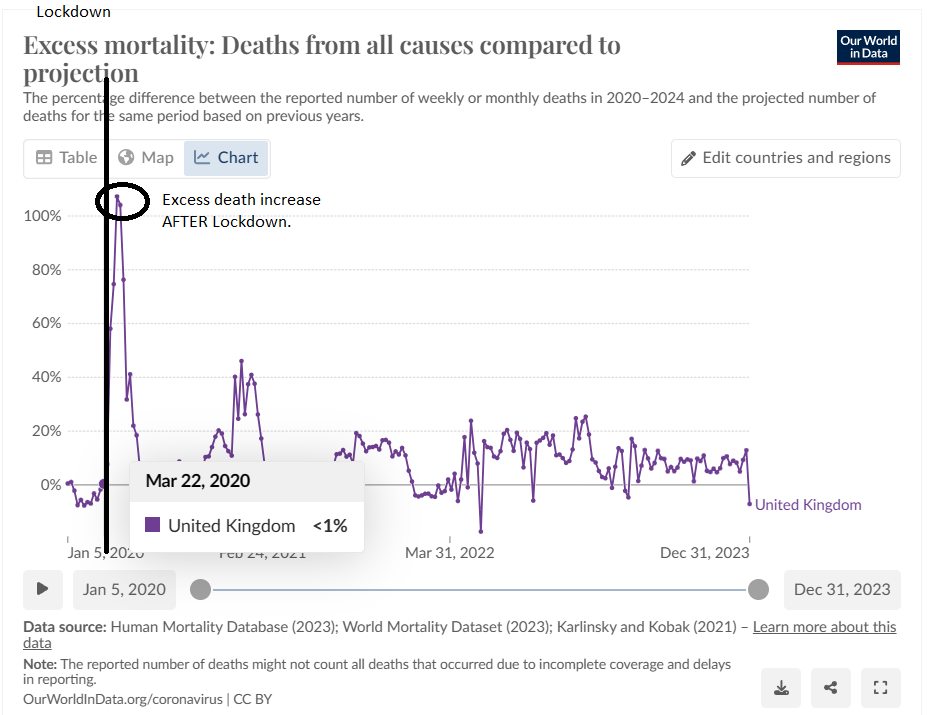
Covid-19 was also an overexaggerated threat. The government and media promoted the idea that Covid-19 was so dangerous that it justified lockdowns, forced masks and experimental ‘vaccine’ technologies. However, reality does not match that apocalyptic vision. In reality, excess deaths in the UK only increased after lockdowns were introduced, not before:

Graph showing excess deaths in the United Kingdom. a black line denotes lockdown, in March. The graph shows a massive spike in deaths shortly after lockdowns were introduced.

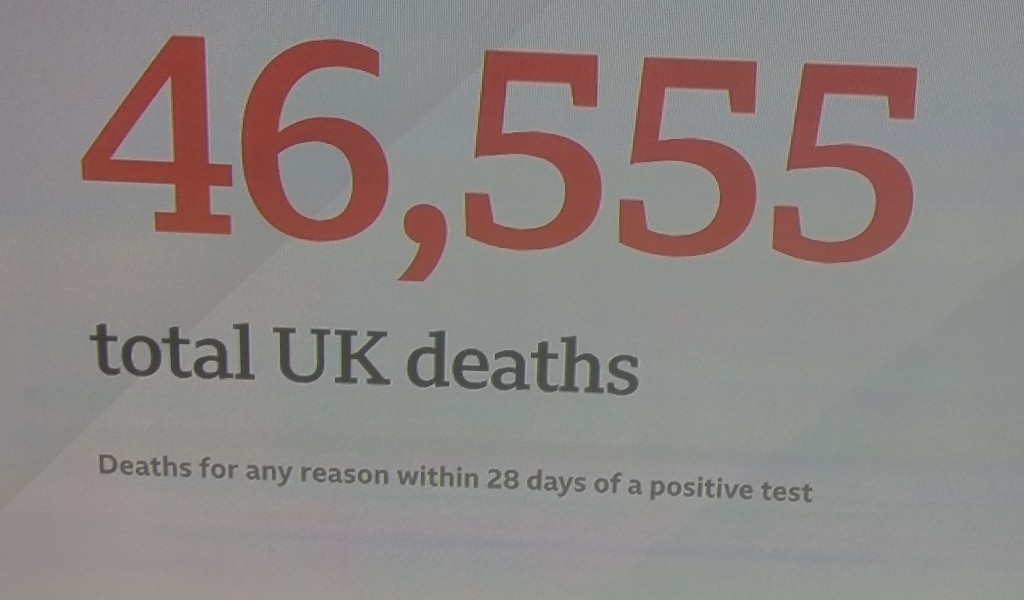
Unlike poliomyelitis, which mainly affected children, Covid-19 deaths were mainly among the elderly. It was rare for young and healthy people to die from Covid-19. The number of deaths from Covid-19 were exaggerated by media, by defining Covid-19 death as ‘death within 28 days of a positive test’ regardless of cause:

Image showing a screenshot from BBC News showing in large red text the number 46,555. Underneath the number it reads Total UK deaths, and then in smaller text 'Deaths for any reason within 28 days of a positive test'.

Science Saves the Day

In both of these cases, heroic vaccine scientists were portrayed as fighting the evil disease through their ingenuity. The key difference would be that in the case of polio, there was more focus on Jonas Salk, the creator of the first polio vaccine to be used on a mass scale, as an individual. Whereas, in the case of Covid-19, the inventors behind the vaccine were not mentioned, with the names invoked being that of pharmaceutical companies. This may indicate a changing of the times, in that science in general has come to rely much less on the individual ‘heroic inventor’ and more on mass bureaucracy.

Rushed Vaccine Approvals

Both vaccinations also had rushed approvals. After the success of the vaccine was announced at a press conference, the FDA approved the vaccine immediately. The Covid vaccines also had extremely short trial periods, but were pushed through under Emergency Use Authorisation under the guise of a ‘pandemic’ in the US and later formally approved.

Mass Participation

One of the key comparisons between these two vaccines was the opportunity for mass participation they provided. This was not just some sort of out there ‘science’ but a real opportunity to participate in the ritual aspects of vaccination practice. There are two key differences: in the Salk vaccine, the mass participation event was the clinical trial, whereas in the Covid case, the mass participation event was the roll out of the vaccine in December 2020. In the Salk case, the participants were children, whereas in the Covid case the participants during the initial furore were adults.

The Salk vaccine had a large number of participants:

Across the United States, 623 972 schoolchildren were injected with vaccine or placebo, and more than a million others participated as “observed” controls.

“A calculated risk”: the Salk polio vaccine field trials of 1954

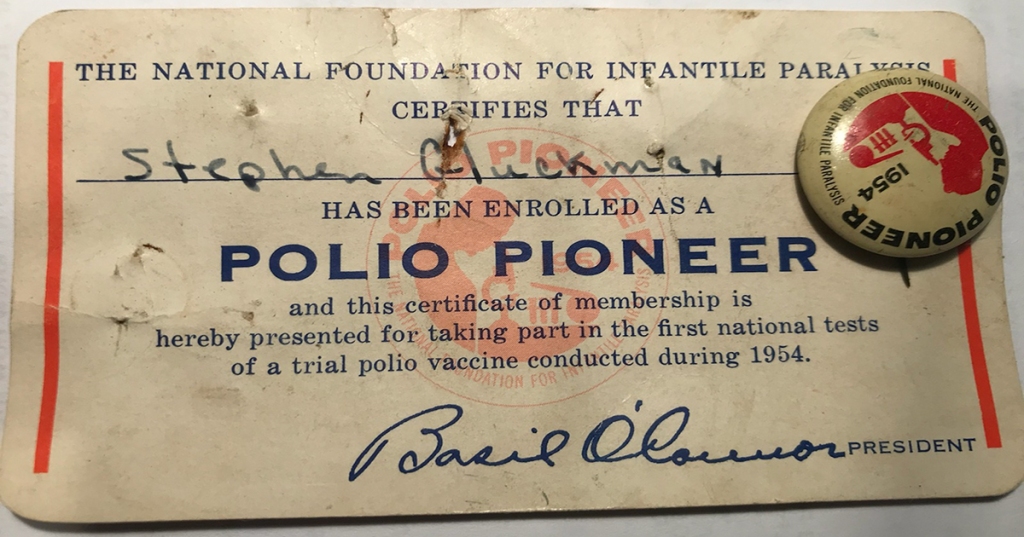
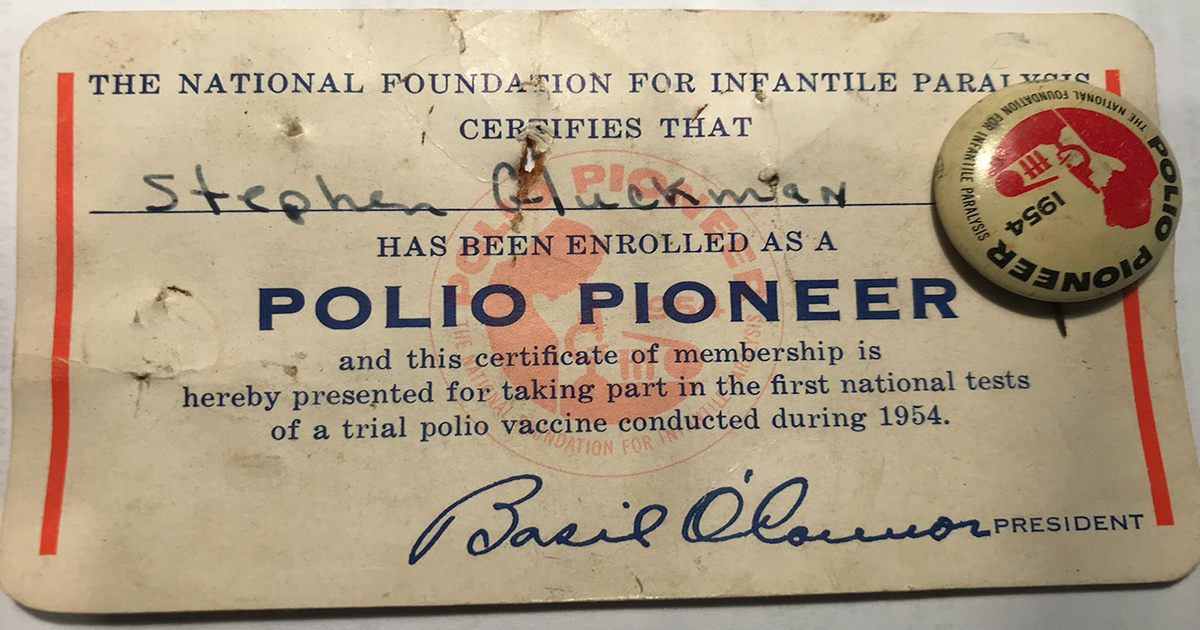
Children were put forward to participate in the trials by their parents, and were called the ‘Polio Pioneers’. They were given badges and certificates as a reward for being injected with the vaccine:

Image shows a worn certificate with the text: "The National Foundation for Infantile Paralysis Certifies that Stephen Gluckman has been enrolled as a Polio Pioneer and this certificate of membership is hereby presented for taking part in the first national tests of a trial polio vaccine conducted during 1954. Basil O'Connor, President. The image also displays a badge with the text Polio Pioneer 1954 The National Foundation for Infantile Paralysis.

[Gluckman is a promoter of Covid 19 Vaccination]

Images of smiling children holding their arms after receipt of the vaccine were promoted in the mass media.

With Covid-19, the mass participation aspect, and the elements of ritualism, came after the clinical trials rather than before. Images were shown of people receiving vaccines, including seemingly gimmicky stories about a man named William Shakespeare receiving a Covid vaccine (complete with imagery).

Because Covid-19 vaccines allowed for adult participation, social media images were used as a means to demonstrate participation in the ritual of vaccination. Ordinary people were given options on platforms like Facebook to put a ‘I’ve had my Covid-19 Vaccine’ banner on their profile as a form of showing that they had taken part in the vaccine ritual.

Both of these strategies for vaccine promotion were dependent on mass technologies that reach the entire country. Mass newspapers, television, and social media were required to sustain this message. But they also required individuals (or their parents) to opt in to this ritual performance on the basis of this propaganda.

In both cases, we see this initial enthusiasm is not maintained. Many people gave up taking Covid vaccines after the first booster, and enthusiasm for the Salk vaccine also waned quickly. Problems such as the Cutter incident, in which the vaccine caused poliomyelitis, caused scepticism. In the US, it was replaced by the Sabin vaccine after this vaccine was field tested in countries like the USSR.

Conclusion

Vaccine campaigns in the 20th and 21st centuries have used mass media as a strategy to create emotional linkage to the idea of taking a vaccine. Encouragement to participate in such events are a means of manipulating the public into vaccination. The idea of ‘being part of’ such a mass project by opting in provides meaning and purpose, and allows the individual to believe that they are playing a part in the banishment of evil.