Anti Digital ID Protest Birmingham 20 December 2025

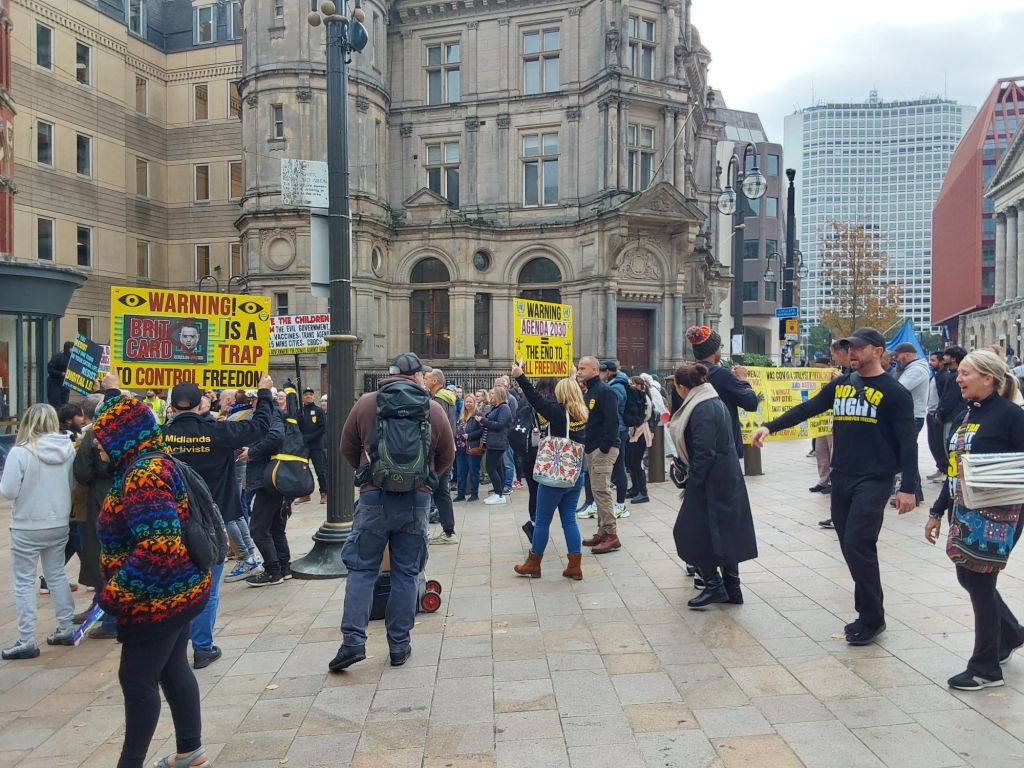
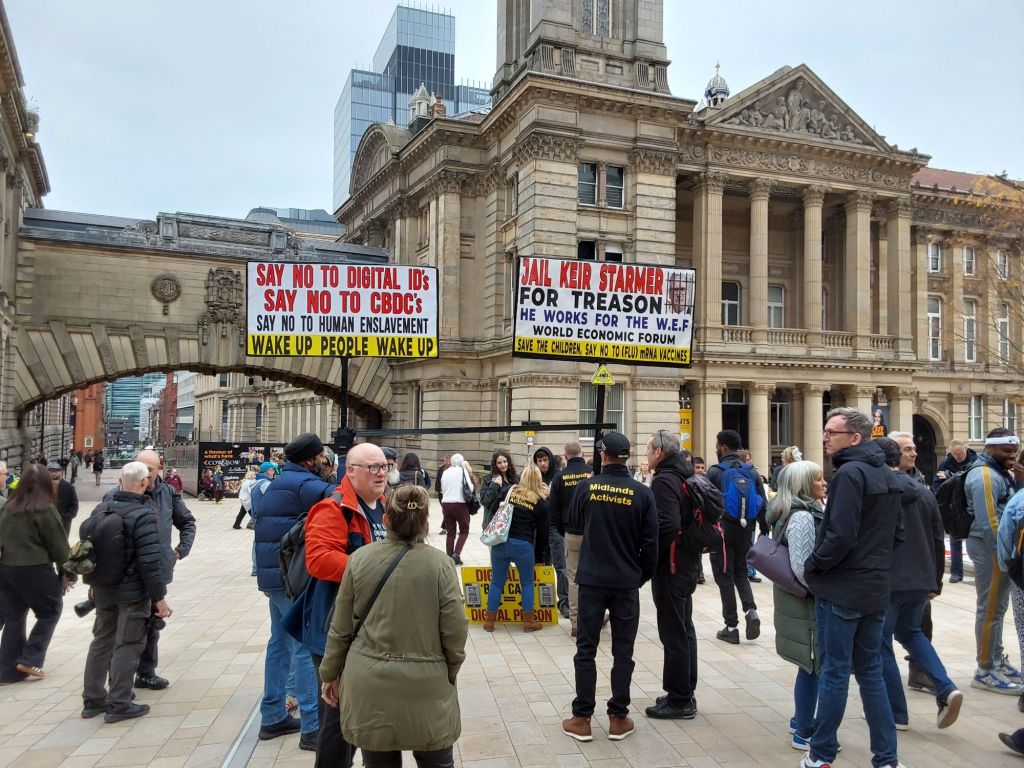
This was the next monthly protest in the series.

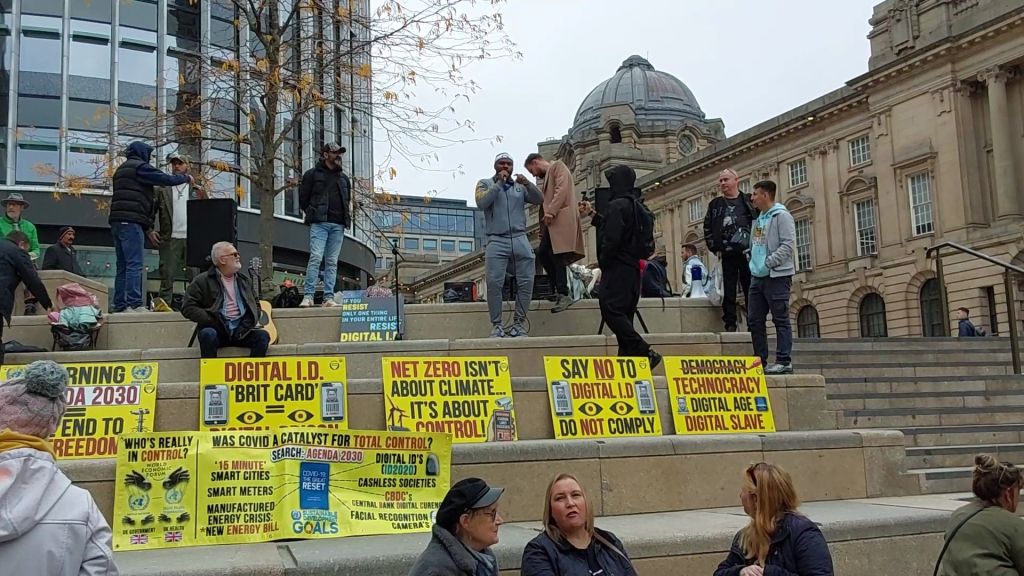
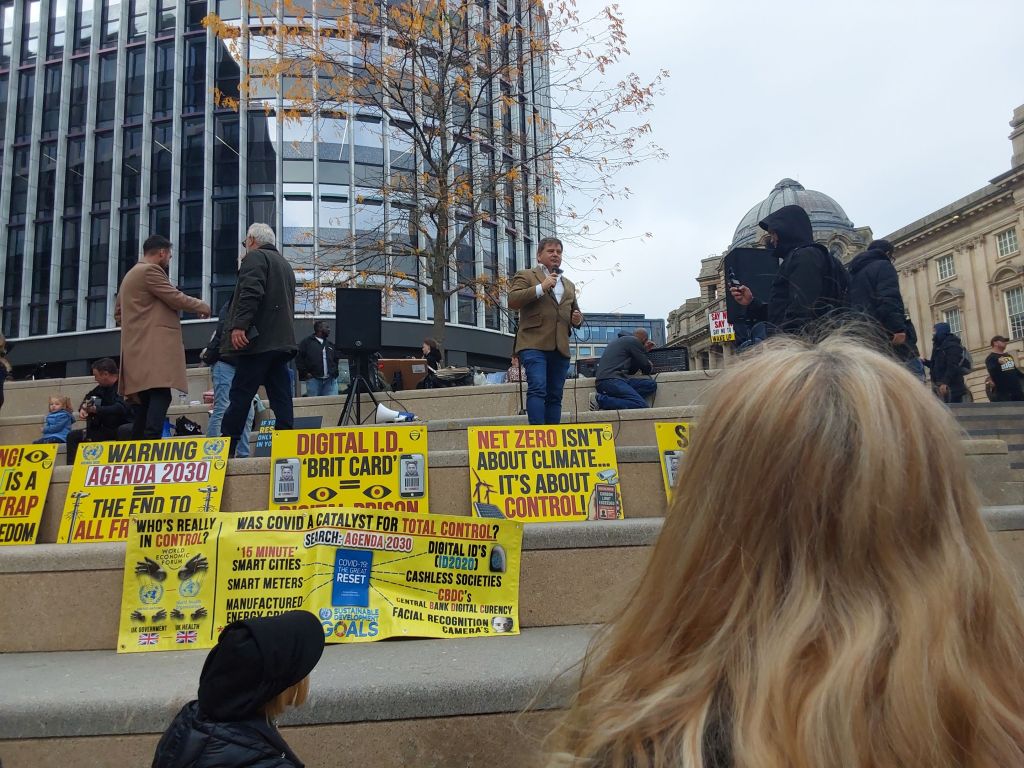
On this occasion there were three main speakers, former Conservative politician Andrew Bridgen, David Icke, and Covid vaccine injured John Watt.

Former Conservative politician Andrew Bridgen

Andrew Bridgen spoke for about 4 minutes. The main theme of his speech was that digital ID is a one way street – once its introduced, it will be very difficult to get rid of. He said even if you are deluded enough to trust the current government, supporting digital ID is going to require trusting every future government. There is also a risk that the Labour government may come up with an excuse to cancel the 2029 general election. Digital ID is required for Agenda 2030, such as vaccine passports and carbon credits.

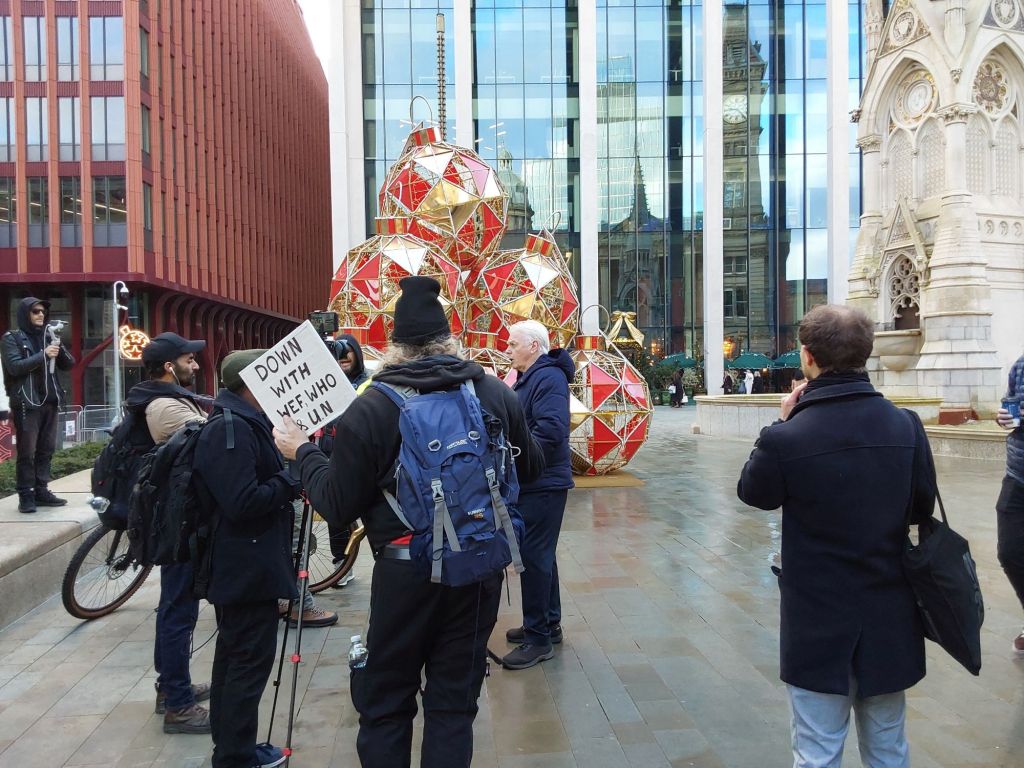
David Icke giving an interview in front of oversized Christmas baubles.

David Icke gave a long speech discussing what he called the global cult. There are similarities across countries due to the control over humanity by this global cult. The aim of this elite cult is to promote artificial intelligence and transhumanism as a means of control. The likes of Ray Kurzweil have made this agenda clear through their promotion of ideas such as the Singularity and the interlinking of AI and the human brain.

Elected politicians are deliberately idiotic and deliberately selected by the global cult to be do, so that people will be more willing to accept technocracy. They promote rigid belief systems and ideological conflict for control. Alternative media is too focused on issues like who killed Charlie Kirk, rather than exposing the real agenda.

It is better to remove the source of the problem rather than to talk about solutions. We need to stop believing in rigid belief systems as these are used for control.

John Watt spoke about the difficulties of getting help when injured by the Covid vaccine. It was good to see him give a speech since I believe at one point he was bedbound due to his injuries.

The next protest is 24th January. I will also cover that protest.

Anti Digital ID Protest Birmingham 8 November 2025

Man in a maroon shirt stands in front of a banner reading 'Say No to Digital ID'

There was another protest against the government’s Digital ID scheme on 8 November 2025. This was in the same location, Chamberlain Square, Birmingham.

Two people holding a banner reading 'Birmingham Rejects Digital ID, Freedom doesn't need a pass, we stand together'

There were fewer speakers at this event, instead there was some live music as well as speakers. Then there was a march around the city centre. They had also set up a TV screen partway through the march advertising the next protest.

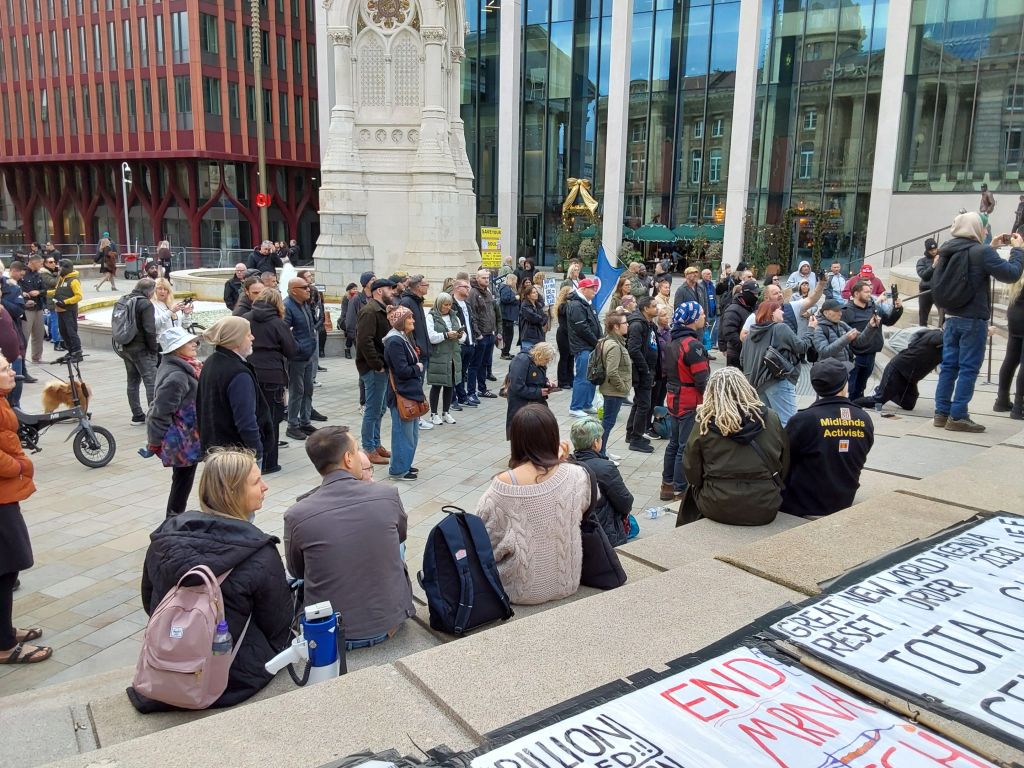
Crowd sitting on steps and standing at the bottom of steps in front of large water fountain

The crowd was a similar size to last time. The speakers included an Army veteran and Fiona from the Mass Non Compliance campaign. She gave a speech focusing on the government’s One Login and the international actors who are supporting tyranny such as the WEF.

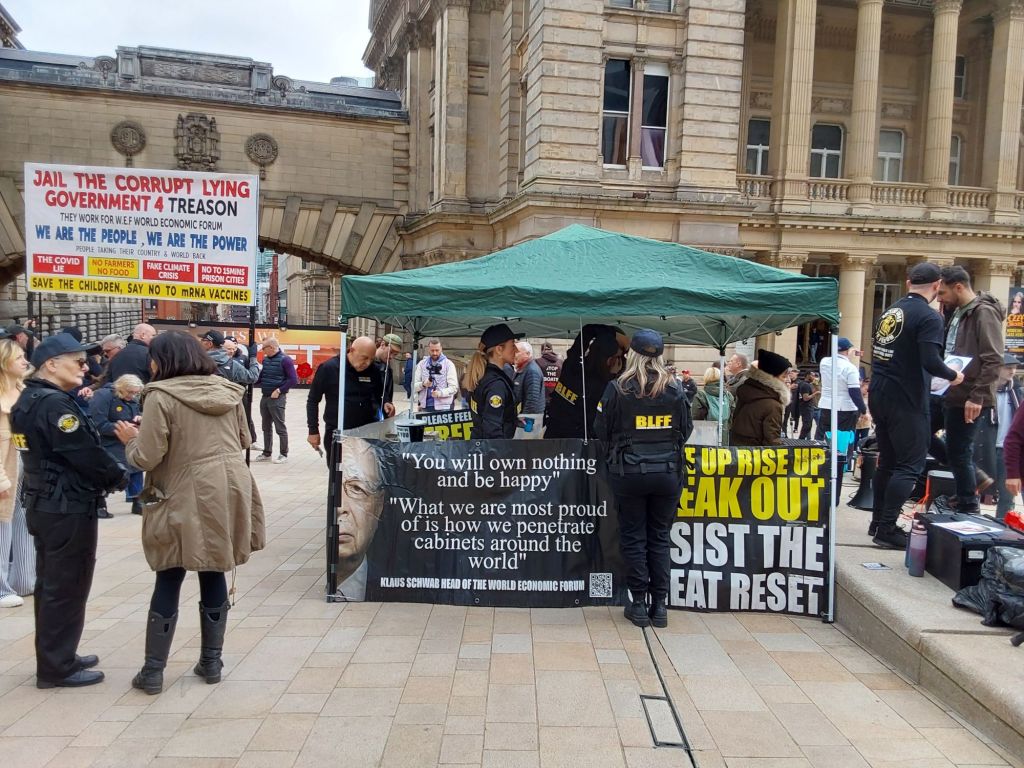
Booth giving out information with quotes from Klaus Schwab on a banner 'You will own nothing and be happy'

Some video footage from this protest and the last one has been uploaded to my YouTube account. As of yet it hasn’t been censored. I plan to upload the videos to Odysee as well but you have to reformat everything and I haven’t yet had time.

The next protest in Birmingham is 20 December 2025 with David Icke.

Anti Digital ID Protest Birmingham City Centre 11 October 2025

I went to a protest against Digital ID in Birmingham City Centre  on 11 October, 2025. I have taken some photos and video for upload (the videos will be uploaded at a later date).

The themes of the protest were basically what you would expect. There were still quite a lot of references to the Covid issue and the vaccines. Rameece, a rap artist who had previously attended some anti-Covid events, did his rap song about the Covid vaccine.

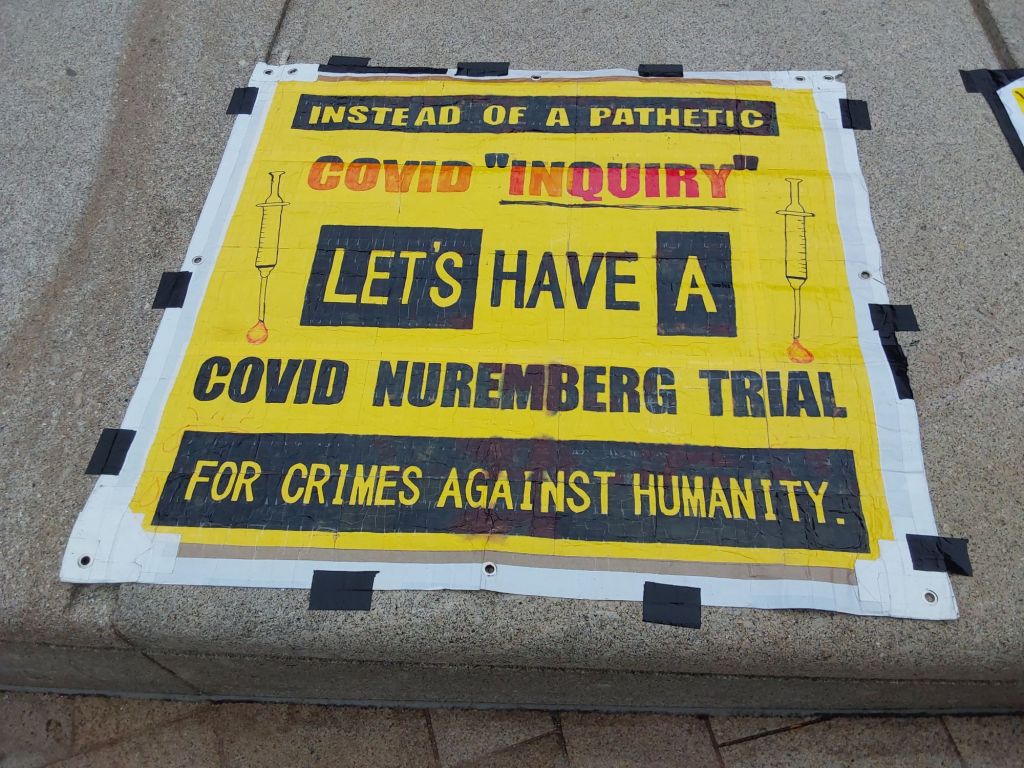
Sign taped to a step reading Instead of a pathetic Covid inquiry, let's have a covid nurenberg trial for crimes against humanity
One example among many of Covid themed signs
Rapper Rameece performing song against Covid vaccine
Rameece

Other themes that came up were 5G, the One Login system implemented by the government and its relation to digital ID, and other authoritarian surveillance legislation such as the Onljne Safety Bill. As well as usual themes of criticism of the claims of climate change, Agenda 2030, the UN, WEF, etc.

Protesters marching against Brit Card holding yellow signs. Sign reads Warning Brit Card is a trap to control freedom

The attendance for this protest was a few hundred people. It looked like primarily the people who used to attend the anti lockdown protests, I recognised several faces from those events.

Protesters holding signs reading Jail Keir Starmer for Treason, Say No to Digital IDs

Politician Andrew Bridgen also attended the protest.

He said that he knows a Labour MP who has admitted he essentially votes with the Labour whip (for non UK readers, the ‘whip’ enforces voting with the party) without even reading the legislation. 

MP Andrew Bridgen stands at the top of the stairs. Multiple yellow signs with text criticising digital ID, agenda 2030 and net zero and below him.
Andrew Bridgen

There has been an update on Digital ID since my last post. This is the new digital Veterans ID where people can prove they served in the military to get certain benefits.

I would also recommend giving Iain Davis’ article on the Brit Card a look (linked above), where he argues that the Brit Card is a distraction (politically untenable) from the real digital ID that is/will be introduced.

We should still continue to make our voices heard against all forms of digital ID. I know I haven’t done many protests recently but I plan to continue being involved in this campaign where possible.

Starmer’s Digital ID Plan

Introduction

The UK government led by Kier Starmer has recently announced that they intend to introduce a Digital ID scheme. This article will look at the roots of this scheme in a UK context, the arguments they will be using to support it, and the reasons why this is a planned step towards government tyranny.

Background

Kier Starmer is the leader of the Labour Party and this particular party has a history of wishing to bring in national ID cards.

Under the Tony Blair government (1997-2010), there was a plan to introduce ID cards. In 2006, the Labour government passed the Identity Cards Act. This act was designed to provide biometric cards backed by a government database. These were physical cards (as smartphones etc were not in mass use).

The government did introduce a pilot scheme in 2009 for these cards where people could apply for them, and around 15,000 cards were issued.

However, the scheme faced significant opposition. There were some protests against the plan, as well as opposition from other political parties. Part of the opposition was based on the fact that any such scheme would be extremely expensive, and part of it was based on surveillance/police state concerns.

The scheme was scrapped by the Conservative/Liberal Democrat coalition government after they took power in 2010.

The New Scheme

The new scheme suggested by Starmer has been outlined in the mainstream media as follows:

  • It will include a name, date of birth, nationality or residency status, and a photo
  • You won’t have to carry IDs around
  • You’ll never be asked to produce it – other than when proving a right to work in the UK
  • The ID will be on people’s phones – similar to contactless cards
  • It will be compulsory for anyone looking to work in the UK

List taken from the BBC report on the ID card scheme.

Arguments

The main argument being used by Starmer to back his scheme is that digital ID will help to combat illegal immigration. Starmer is very unpopular in the UK at the moment and one reason is that people are dissatisfied with his response to small boat crossings of people illegally entering the UK, and ‘migrant hotels’ where migrants are kept while claims for asylum are looked at. As a result, poll results are showing a significant swing towards the anti immigration party Reform UK run by Nigel Farage. As such, he hopes to boost his popularity by announcing this scheme as well as normalise a plank of planned government authoritarianism.

The argument being made is that by having a Digital ID, it would make it more difficult for illegal migrants to work in the country, reducing the ‘pull factors’ that cause people to illegally enter the country. The government also argues that it will more quickly allow people to verify their identity when accessing government services such as welfare benefits to prevent fraud.

Problems

I don’t want to spend too much time outlining the issues of Digital ID as I think they are fairly obvious to my readers. One argument that has been made by some, that I would like to bring up, is the issue of whether it would work. Farage has criticised the scheme, partially on grounds that it would be ineffective. I personally think we shouldn’t focus on the effectiveness argument either way. We shouldn’t want Digital ID even if it was 100% effective against illegal migration.

The main thrust of any argument against Digital ID should be the state tyranny aspect. Once the infrastructure is established, there is nothing stopping creeping expansion of the scheme. Mahmood, the Home Secretary, has already agreed that this can/will happen. Digital ID can be linked to any aspect of life, for example, vaccination status, which the government could use to force people to behave in particular ways.

Conclusion

There has already been much concern from the public about the use of Digital ID. The scepticism towards the scheme must be mobilised as means to prevent further state tyranny. Hopefully the unpopularity of the Starmer government combined with resistance to the scheme can prevent it ever being introduced.

A Brief History of British Antivaccinationism, Part 3.2: White, Creighton and Crookshank

Introduction

This series hopes to explore the history of British Antivaccinationism and Vaccine Scepticism.  It is divided into 7 main eras: the period of Inoculation, 1721-1798; the introduction of vaccination, 1798-1853; the imposition of mandates, 1853-1898; the remaining history of the National Antivaccination League, 1898-1972; DTP Vaccine Scepticism 1972-1998; Andrew Wakefield and vaccines cause autism, 1998-2019, and Covid 19, 2020 to present. This section forms part 3.2 looking at three main antivaccinationists active in the late nineteenth century, William White, Charles Creighton, and Edgar Crookshank.

William White

White authored a book called Story of a Great Delusion in 1885, looking at the history of inoculation and vaccination from an antivaccinationist perspective. It covers the entire period from the introduction of inoculation up to what was then the present day.

The book is primarily a historical account and he goes into detail not just about Jenner but the research of other important vaccinationists, such as George Pearson, another notable doctor, and William Woodville, doctor at the Smallpox Hospital in London. It explores their tense relationships and goes into more detail about Jenner’s personality (he had a significant habit of falling out with those who mostly agreed with him).

He also goes into the history of the government role in vaccination, such as the provision of vaccine lymph by the National Vaccine Establishment, and how £3,000 was budgeted for lymph, as an attempt to spread vaccination among the poor. He argues that Jenner’s ability to argue with everyone was one factor why government intervention was necessary to ensure the continuation of vaccination, rather than a reliance on private institutions.

He covers the introduction of the vaccine mandate – essentially the increasing intertwining between vaccination and government – and the introduction of ideological vaccine resistance, such as the founding of The Anti Vaccinator pamphlet by John Pickering.

Throughout the book he does make some arguments explaining why vaccination is a flawed practice, such as that it simply exchanges one disease for another while not decreasing death rate and that vaccine compulsion is purely about medical industry profit, rather than effectiveness. White believed the ineffectiveness of vaccination had been well demonstrated by the mandate introduction in 1853.

Charles Creighton

Dr. Creighton was a physician of note in the late nineteenth century, who completed a famous work on the history of epidemics in Britain. He was primarily interested in medical history rather than being a practicing doctor.

The story of how Dr. Creighton became an antivaccinationist is rather interesting. He was approached by the Encyclopedia Britannica to write an article on ‘Vaccination’ for their new edition. Feeling it was only justified to research the topic if he was going to write about it, he did – and became an ardent antivaccinationist. Perhaps surprisingly, the Encyclopedia agreed to publish whatever he wrote, so that edition ended up containing an antivaccinationist account.

He wrote two books condemning vaccination in 1887 and 1889.

His book Cowpox and Vaccinal Syphilis goes into great detail on the topic of vaccine lymph. This included the historical disputes between Jenner and Woodville, and whether the two sources were equivalent. Jenner had issues obtaining cowpox lymph for vaccination, and this whole issue tied into the debate about ‘spurious cowpox’, which was one of Jenner’s excuses for vaccination failure. The primary argument in the book in terms of the dangers of vaccination is that cowpox is completely unlike smallpox, and is actually closer to syphilis (which was historically known also as ‘great pox’). There had been an increasing number of deaths from infantile syphilis after the vaccine mandate was introduced. In Creighton’s view, cowpox was causing this syphilis increase.

Jenner and Vaccination is a more general work on vaccination as a whole. He argues that Jenner used sleight of hand to redefine cowpox as variolae vaccinae (which literally means, cow smallpox). This manipulation led people to accept similarities between the two diseases that did not exist. Jenner also defined cowpox as a mild disease despite significant issues of ulceration to gain support for vaccination. He also argues that because Jenner used a very mild form of inoculation (deliberate infection with smallpox) to ‘test’ whether or not the vaccinated had immunity, this led to false claims of immunity. The mild (known as Suttonian, after Daniel Sutton) method of inoculation caused only a small effect anyway, so it having little to no effect after a cowpox inoculation proved nothing. He also mentioned the redefinition of smallpox as chickenpox after vaccination to avoid accusations of vaccine failure.

Creighton became involved in the National Anti-Vaccination League, and ended up being excluded from the mainstream medical community.

Edgar Crookshank

Crookshank published two volumes addressing vaccination in 1889. The second volume is a compilation of essays about vaccination and varying vaccination experiments performed by its advocates. As such we will focus on the first volume as that contains Crookshank’s actual arguments.

History and Pathology of Vaccination makes several arguments. One of the most interesting is Crookshank’s analysis of Jenner’s two different versions of his original paper on vaccination. Jenner originally tried to publish a paper on vaccination in 1796 via the Royal Society, but they rejected the paper. Instead, Jenner published the paper himself in 1798. There are significant differences between the two. Jenner did add more experiments and cases in an attempt to bolster his argument (the original paper had only contained the vaccination of James Phipps, one case). He also sought to tone down the negative effects of cowpox in the new paper, and attribute issues with the disease as incidental effects not directly caused by cowpox/vaccination.

A second argument made by Crookshank is to discuss all the different sources that were used as vaccine lymph, explored further in this post.

Conclusion

This period was the height of Britain’s history of resistance to vaccines, and this included the number and intelligence of those resisting vaccination. There are many critics who I have not covered, also active during this time, such as William Tebb and Alfred Russel Wallace. But there was more than intellectual resistance – there was popular resistance from the working class, the topic of the next article in this series.


Intact Parents, Injured Children: A Discussion of the Inherent Tension in the Vaccine Injury Movement

Think about what the CDC’s grotesque vaccine schedule does to the relationship between parents and their children. The kid does not know what’s going on. Yet every few months the parents offer up the child to strangers who inflict pain with sharp metal objects while smiling, laughing, and saying “it’s okay,” “you’re a champ.” The shots can cause fever, digestive problems, seizures, and worse for days, months, or even years. The parents go through this Molochian ritual over fifty times. The child has no words to express what’s happening. The child cannot possibly give consent. The psychological scars from this betrayal are permanent and the child learns to never trust the parents again.

Dr. Toby Rogers

Parents teach the idea of not following herd mentality. How many times have parents said “If so and so jumped off a cliff, would you?” to their children? How about this – if the white-coat told you to push your own child off the cliff, would you do it? Of course the answer is no, it’s only yes if the cliff is disguised as a sterile lighthouse shining light across the sea of disease. But nevertheless – if the white-coat told you, would you do it? Everyone is aware of the Milgram experiment. Vaccination is society’s Milgram experiment writ large, so insidious the authority of the white-coat that parents will destroy their own children.

Let’s see how this goes. A parent takes their child to be vaccinated, seeks the white-coat for the ‘well baby check-up’. Or perhaps not, perhaps the parent has some doubts about the shots, but the authority of the white-coat’s fanaticism removes this well enough. The child – probably in discomfort, fear, receives the holy baptism of the injection. However when they get home they aren’t right. They are having seizures, or a fever (dosed with paracetamol/acetaminophen no doubt, which aggravates the injuries). Then everything gets worse. The child stops speaking, stops making eye contact, loses skills. The white-coat gaslights the parent and claims the child was always this way, always damaged. The parent knows this is a lie, as there is nothing wrong with their memory.

The parent seeks those in the same boat with them, and the few doctors who will not lie to them about their children’s injury. They speak out about the child being vaccine-injured. They unite with other parents to tell the truth about vaccines. They promote and amplify doctors and experts telling the truth about vaccines. So far there is no problem: the gaslighting establishment medics need to be exposed as liars and frauds. Parents can give powerful testimony to the way their children were destroyed by vaccines.

So where is the problem?

The reality of the vaccine-injury movement – with the exception of the Covid ‘vaccine’, and to a lesser extent the Gardasil vaccine – is that the vast majority of those speaking are parents. This certainly applies very strongly to specifically autistic vaccine-injury. In part this is out of necessity: some autistic people are simply too severely vaccine-damaged to communicate regarding their injuries. In part this is out of the success of the ‘neurodiversity’ movement that convinces those with ‘high functioning’ autism that autism makes them special and unique and that there is nothing wrong with it. Nevertheless this necessity creates a skew, that those with are personally autistic vaccine-injured don’t get a voice or a prominent role in the vaccine-injury movement.

You can try this for yourself: when you think of people speaking about autism and vaccine injury, who first comes to mind? When I test this on myself, I come up with Robert F Kennedy, Jr, Andy Wakefield, JB Handley, Jenny McCarthy, Christopher Exley, Del Bigtree, you get the idea. No autistic people whatsoever. This creates a problem. Parents can articulate what they observe their child do and the distress of their child from the outside. Any medical professionals can describe what they have seen in injured children. Journalists can accurately describe the corruption. Doctors and journalists and advocates but no-one of any profile is doing this from the inside.

But now we must trespass on even more controversial territory, that is the question of guilt.

Does anyone else know what a paradox it is? That I can appreciate parents who speak out about their child’s vaccine injuries while feeling such bitterness and anger? To know that your parents love you but that they also ruined you for life?

And then this brings us to the most fundamental question: who is ruined? We can do this in a very simple way. Let’s use an example. Andy Wakefield has talked in interviews about the children in his 1998 Lancet study and how the parents of the vaccine-injured children were told that they should stick their child in a home, because ‘that’s autism’ and nothing could be done to help them. What is unsaid that – well fundamentally, that’s true. Not in the sense that nothing could be done to ease the child’s suffering, necessarily – but in the sense that the parent has the full capability to abandon their vaccine-injured child and walk away, whereas the child has no such luxury to abandon their vaccine-injuries. Don’t misunderstand me: I am not saying that this would be easy to do or would cause no distress to the parent. Just that it is possible: and therein lies the problem. The parent is intact: distressed, angry, feeling guilt, but nevertheless intact.

Parents of vaccine-injured children need to unconditionally be defended from the gaslighting mainstream medical establishment. I am happy to put my bitterness and anger aside for The Cause. After all, nothing matters more than making sure that there are no more human beings like me. But I will never be silent, and if there is a certain amount of discomfort in that refusal, then that is how it will have to be.

Image source: Photo by Ray Bilcliff on Pexels.com

The UK Media is still promoting Transgender Activism

Introduction

A few months ago, there was a UK Supreme Court ruling that stated for the purposes of the 2010 Equality Act, sex is biological, and that woman and man in the legislation refer to sex and not gender identity. Despite this rare application of common sense in a UK Court, the media is still promoting transgenderism as a desirable ideology.

Context

In a world context, the UK has had the strongest and broadest base of resistance to transgender ideology. People of different political views from conservatives to radical feminists to moderate liberals have pushed back. Both religious people and atheists have pushed back. This has led to the UK becoming known as TERF (trans exclusionary radical feminist) Island, originally meant as an insult but reclaimed as a point of pride by UK opposition to transgender ideology.

While there has also been increasing pushback in the US under Trump, much of it is based on executive orders. Executive orders that prevent a child being prescribed dangerous drugs and surgeries have a great positive effect in general but are not the same thing as the broad based opposition we see in the UK. Also, they can be overturned with a new president. In other western countries, we are still seeing victories for the transgender movement such as Self ID in Germany.

However the UK media has (deliberately) not got the message that this ideology is increasingly unpopular here. I will describe some examples below of the media doing this. Of course because these are long term projects they were commissioned before the Supreme Court ruling but still provide valuable insights into the media and this ideology.

Case 1: Munroe Bergdorf

Munroe Bergdorf is a man pretending to be a woman, who is relatively high profile in the UK.

I won’t go into his history in massive detail, but I will note that he has previously been heavily criticised for demonising all white people as violent and evil. He once said:

Once white people begin to admit that their race is the most violent and oppressive force of nature on Earth… then we can talk.

In other words, ignoring the fact that psychopathic elites and pursuit of wealth and power regardless of race are the sources of imperialist violence and instead blaming white skin colour.

Anyway, he has a new documentary out, about what else – himself. The documentary is called Love and Rage, and no, I won’t be watching. If you want a review, you can see this link.

In a promotion for this documentary, he did an interview with the ‘Metro’ newspaper. This is a free newspaper given out primarily via public transport networks. I take a copy for the cryptic crossword and happen to see this interview in the paper. Quotes and comments are based upon the interview “60 Seconds with Munroe Bergdorf” in the Friday, 4 July issue of the paper.

Much of the interview is just fluff to promote his film. However I will comment on a few things he says in the interview. One of them is to complain about being attacked on social media. Of course, since one of the main outlets for promoting transgenderism is social media, this is mildly amusing. He then equates refusing to acknowledge he is a woman with refusing to acknowledge he is a human being. Of course, even the most ‘transphobic’ person on the planet acknowledges that Bergdorf is a human being – just that he happens to be male and cannot change sex.

He then promotes falsehoods by stating that the Supreme Court ruling “has basically defined us out of the Equalities Act”. He doesn’t acknowledge that one of the nine categories under the act is “Gender Reassignment” i.e. transgenderism. Of course he can’t even get the name of the legislation correct, as it is the Equality Act, which demonstrates his complete ignorance. Now from my point of view (without getting into broader questions of the state, state authority etc.) transgenderism should not be protected in law because it is a sexual fetish (autogynephilia) and/or a sexual strategy (gay men who ‘transition’ to try and get ‘straight’ men to sleep with them). No other sexual fetishes are protected in law.

He states he will continue to be a sexual pervert and use women’s toilets and complains that ‘if you look too much like a woman’ you can’t use the men’s. Ignoring the fact that in reality, 99.9% we can tell you’re a man. Women are generally quite good at spotting them as we have to be alert to the presence of men due to sexual violence. Or as I like to say Instagram filters do not exist in real life.

That’s not all the nonsense in the interview but serves as a sample of the sort of thing being promoted in the mainstream media

Case 2: The “I Kissed a Boy” Dating Show

‘I Kissed a Boy’ is a supposedly homosexual dating show for gay men. Now I don’t watch this sort of stuff as I have no interest in it. But it came to my attention because this dating show supposedly for male homosexuals includes a woman among the cast, who calls herself Lars and pretends to be a man. Of course, these women are not homosexual males. A significant motive for this is sexual fetish, as women fetishise gay male relationships specifically, which is why they seek to be accepted as ‘gay men’. Some of these women even try and trick/pressure gay men into sex with them.

This follows the trend of seeking to redefine homosexuality as ‘same gender’ attraction rather than same sex attraction. (Of course, this also redefines heterosexuality as ‘opposite gender attraction’). Basically this dating show continues to push the ideology that people can change sex and the lie of gender identity.

From the review, it seems like the entire thing is about sex. Of course while sex and sexuality are important parts of becoming an adult it’s hardly the only thing of relevance.

Case 3: “What It Feels Like for a Girl” TV Show

A BBC TV show with this name, of course, is about a male. It is adapted from a book of the same name by a man called Paris Lees. I haven’t read the book or watched the TV series so I won’t be doing a review. Lees, like Bergdorf, is a homosexual male who pursued transgenderism. The book/TV show is meant to be a ‘coming of age’ style story where the protagonist discovers his sexuality/’gender identity’.

The Lies They Tell gave the book (which was released in 2021) the following review:

This book is simply terribly written.  Writing in dialect would be a challenge for an experienced writer and it says a lot about Lees’ ego. However, even if you take the dialect away, all we are left with is the relentless gossipy sniping of a man with almost zero ability for self-reflection.  It’s really hard to read. It has no narrative arc.

The program, of course, is getting rave reviews from the usual suspects, such as the Guardian, a liberal UK newspaper known for promoting transgender ideology.

On a final note, I always find these men calling themselves ‘girls’ entirely creepy.

Conclusion

Transgender ideology is still a prominent force in the UK media despite the recent high-profile defeat in the court system.

Tiny Creature

Tell me.

Tell me the truth.

Do you consent to utopia

A world without horror

At the price of a child?

Liberation from the burden of disease to control your own fear. To discipline it, to tame it by your profession.

It won’t be your tiny creature. The rigours of medicine will not cause them to convulse or to scream.

But an unknown child that will require confinement in four walls – as they thrash and cry until they die – unavenged.

You will hide it and gaslight the price of utopia – the architect cannot choose his conditions, you might say, cannot choose the world he bends to make right.

But he must know the foundation of his edifice is the tiny creature.

So tell me.

Tell me the truth.

This piece references the below quote from Fyodor Dovstoyevsky’s book The Brothers Karamazov, which encapsulates the ideology of vaccination:

Imagine that you are creating a fabric of human destiny with the object of makingmen happy in the end……but that it was essential and inevitable to torture to death only one tiny creature…And to found that edifice on its unavenged tears: would you consent to be the architect on those conditions? Tell me, and tell me the truth!

A Brief History of British Antivaccinationism Part 3.1 – Initial Opposition to the Smallpox Vaccine Mandate

Introduction

This series hopes to explore the history of British Antivaccinationism and Vaccine Scepticism.  It is divided into 7 main eras: the period of Inoculation, 1721-1798; the introduction of vaccination, 1798-1853; the imposition of mandates, 1853-1902; the remaining history of the National Antivaccination League, 1902-1972; DTP Vaccine Scepticism 1972-1998; Andrew Wakefield and vaccines cause autism, 1998-2019, and Covid 19, 2020 to present. Because most active resistance to vaccination is clustered in this period between 1853 and 1902, Part 3 will have three sub-parts, discussing initial intellectual resistance in John Gibbs and Charles Pearce, the later intellectual resistance of William White, Charles Creighton, and Edgar Crookshank, and popular class resistance.

The Vaccine Mandate

In 1853, the United Kingdom introduced mandatory smallpox vaccination.  There was a fine of 20 shillings introduced for non compliance. William White covers the introduction of this mandate in detail in his 1885 book, Story of a Great Delusion. According to White, the mandate was introduced because of the organised interests of the medical profession. There was a lack of discussion on the bill in Parliament, and White states it was an “act for application to the vulgar”, i.e. the working classes. In 1861 and 1867, the level of compulsion was increased, the 1867 amendments made non vaccination a continuous offense and gave the state the power to impose multiple fines.

Prior to the mandate, there was no organised antivaccinationism. There was personal distrust of vaccination among people, particularly the working class, and an apathy of not pursuing vaccination. The mandate triggered new wave of intellectual antivaccinationism, as well as popular vaccination resistance.

John Gibbs

John Gibbs was one of the first to write pamphlets against the vaccine mandate. In 1855 he wrote a letter opposing the mandate. He argued that the mandate was an attack on liberty, and that legislators freely admitted their ignorance on vaccination – relying only on the opinions of the medical profession to pass the bill. He argued that there were statistical issues with the case for vaccination, as there was evidence that smallpox was simply replaced by other causes of death and that there was no decline in the death rate due to vaccination. He also pointed to other diseases spread by vaccination,  such as erysipelas (a form of skin rash and swelling), tuberculosis and syphilis.

He drew attention to the moral issues with government forcing a medical intervention on the people and that this opposed self responsibility. Vaccination was in his view “a state religion in physic”.

Charles Pearce

Charles Pearce was an editor of a medical journal, who received papers from Gibbs, and as a result became an antivaccinationist. In 1868, he authored the short book, Vaccination Its Tested Effects, arguing that “vaccination is a crime against nature”.

Pearce points to the theory behind vaccination, that is the idea that cowpox and smallpox are “governed by the same laws” as an error believed by Jenner. He argues that vaccination is not even practised according to Jenner’s theory, since Jenner believed in a chain from horse-cow-human. Vaccine lymph had been spread from human to human for many decades at this point, and had not been anywhere near passage via a cow. He also pointed to the introduction of revaccination as a contradiction to Jenner’s theory of life long protection from vaccination.

He argued that smallpox vaccination did not save lives, by arguing that smallpox increased longevity if you survived, by the fact that there was an increase in mortality from measles after compulsory vaccination was introduced, and that smallpox vaccination could spread syphilis. He points out that there were ups and downs in smallpox due to the laws of epidemics. He believed sanitation and hygiene were the best methods to combat smallpox mortality.

Conclusion

There was increased intellectual resistance to vaccination after the smallpox vaccine mandate was introduced. This would continue to develop further, and British antivaccinationism would reach its peak between 1880-1902 with the cases made by William White, Charles Creighton and Edgar Crookshank against the practise.

The Smallpox Myth: The Case Against, In Summary

Introduction

The Smallpox Myth is the foundational legend of vaccinology. As goes the story, Edward Jenner realised that cowpox, a disease of the cow’s teat, provided protection against smallpox infection. It came into mass use across the nineteenth century and was mandated in a large number of countries. However there are a number of questions that can be asked regarding this foundational myth, and evidence against the hypothesis that smallpox was eliminated by vaccination.

How Deadly Was Smallpox?

One of the fundamental claims of vaccinology is that smallpox was an extremely dangerous disease that ravaged the world before vaccination. In reality, while smallpox did kill a lot of people, there is more nuance to this discussion. There are two points to consider: was smallpox any more dangerous than any other kinds of zymotic disease (a term historically used to mean eruptive fevers, infectious diseases as a class) and to what degree, and did smallpox cause excess death in epidemic years?

Taking the first question, pro-vaccinationists take the death rate of smallpox to be very high. Jurin, a figure who could be considered an early statistician of sorts in the 18th century and pro-inoculator, argued that around 1 in 6 smallpox infections resulted in death. The accepted figure by the end of the 19th century became around 18%. This is a very high rate. Of course this assumes a smallpox infection occurs, when there were many people who died without ever being infected with smallpox – which means we need more evidence than case fatality rate.

Bills of mortality recorded in London offer some evidence on this score. They show varying death rates from smallpox, depending upon whether it was an epidemic year for smallpox.

However, London data is not extrapolatable to the rest of the country. This is because London was much less sanitary than rural areas and had much higher population density, both of which facilitated the spread of smallpox and a high death rate. This is one of the main problems with the pro-vaccinationist argument – they ignore the conditions in which smallpox existed. Death rates in areas where statistical recording was less fastidious are unknown.

Death Rates from Diseases: Did Smallpox cause Excess Death?

Zymotic diseases were a rampant cause of death in the 17th and 18th centuries in cities due to the terrible sanitation and poor quality diet present in those environments. Was smallpox any worse than any of these other eruptive fevers spreading in unsanitary filth? The key question here is whether smallpox epidemics caused excess deaths, that is deaths above and beyond the average, or whether these deaths were largely interchangeable between different diseases. In order to examine this, we can look at smallpox epidemic years and see whether the overall deaths were any worse than non smallpox epidemic years.

Charles Pearce, in his book Vaccination Its Tested Effects, produced tables to show that vaccination did not lower overall death rates and that other epidemics killed as many or more due to common factors such as poor sanitation and overcrowding. William White argues that Dr. Robert Watt had demonstrated that there was in interchangeable nature to diseases as early as 1813 in Glasgow. This is important since even if vaccination was highly effective if those living in poor conditions would simply die of another disease, vaccination cannot be said to have saved lives.

The Nature of ‘Vaccine Lymph’

One of the main theoretical problems in asserting that vaccination abolished smallpox is the nature of vaccine lymph. Although the simple version of history (and the name itself) tells us that vaccine is cowpox lymph, in reality this is oversimplified.

Many different substances were used as vaccine lymph. One of the most common was to use horsepox instead of cowpox, and this lymph was used by high profile vaccinators and was in wide circulation. Another type of vaccine lymph was smallpox passed through the cow, because they believed that cowpox was smallpox somehow modified via passage through the cow. Other sources were sampled, such as sheep pox and goat pox. So long as the vaccine source raised a correct ‘Jennerian vesicle’ it was considered protective.

The use of various sources for vaccine lymph creates difficulties in believing in its effectiveness as it is difficult to argue that all the extracted sources are equivalent and thus equally protect against smallpox.

Extensive post on vaccine lymph can be found here.

Sanitation Acknowledged – But Ignored in the case of Smallpox

There was some decline in deaths from all forms of eruptive fevers throughout the nineteenth century. This was generally due to sanitary reform that ameliorated the terrible conditions created by city living and the Industrial Revolution. Most people would acknowledge that sanitation was the cause of this decline, but dissent when it comes to smallpox. This is inconsistent logic.

Did Smallpox Decline at the Beginning of the 19th Century Due to Vaccination?

Vaccinationists point to a decline at the beginning of the 19th century as a reason to believe that smallpox declined due to vaccination. However this is flawed logic for a few reasons.

Firstly, it is possible that smallpox declined indirectly due to vaccination. Previous to vaccination, inoculation had been used (that is, deliberately infecting people with smallpox). This practise caused the spread of smallpox in some cases and introduced it to areas where it was not present. The use of cowpox, horsepox, and whatever other substances used for vaccination, regardless of their problems, were not capable of spreading smallpox. This meant that replacing inoculation with vaccination reduced the spread of smallpox but this had nothing to do with the effectiveness of the practise.

The second issue with this logic is that vaccinationists generally argue that most of the population has to be vaccinated for it to work, they call this herd immunity. Yet, whether the majority of the population was vaccinated at that time is a highly dubious proposition. Vaccination spread quite rapidly among the elite in Britain, but the working classes were a different matter. While there were some attempts by Jenner’s followers to offer free vaccination to the poor, it is doubtful this reached the 90-95% of the population required by vaccinationist claims of herd immunity. White shows evidence that under the first few years under the National Vaccine Establishment, which provided vaccination free of charge to the poor, that births far outstripped children vaccinated. This shows many working class people were not even bothering with free vaccination.

The 1871 Smallpox Outbreak

There was a very large smallpox outbreak across Europe in 1870-71. Focusing in on the United Kingdom, mandatory vaccination had been in force since 1853, nearly 20 years. Due to this policy the majority of children were vaccinated, although there were some conscientious objectors. Working class families could generally not afford the fines associated with vaccination refusal, particularly after the mandate was made more stringent in 1867.

Vaccination did not prevent this outbreak. Pro-vaccinationists tend to argue that this outbreak started with the unvaccinated, but this is not relevant. If vaccination was protective, it would not matter if the outbreak started with the unvaccinated, as the vaccinated should be protected regardless if it was effective.

The Case of Leicester

Leicester – a city in the United Kingdom – turned against vaccination after the 1871 smallpox outbreak. Most children in the city were no longer vaccinated, and in 1885, there was a huge protest against the mandatory vaccination law introduced in 1885. Instead Leicester practised quarantine to reduce smallpox infections.

Vaccinationists would predict that Leicester would have severe smallpox outbreaks and a high number of deaths. However, this was not the case. J. T. Biggs, in his book Leicester: Sanitation versus Vaccination, explained how the statistical evidence showed Leicester outperforming other more vaccinated areas in death rates.

Vaccination Declines – So Does Smallpox

After the vaccination mandates were loosened in the early 20th century, vaccinationism would predict a resurgence in smallpox. However, this did not occur. In fact, smallpox continued to decline.

Conclusion

The case for vaccination eliminating smallpox – one of the central myths of vaccinationism – is much weaker than vaccinationists would like to suggest.